
For young South Africans trying to break into the automotive industry, the biggest obstacle is often not a lack of interest. It is getting that first opportunity to turn mechanical interest into recognised workplace experience.
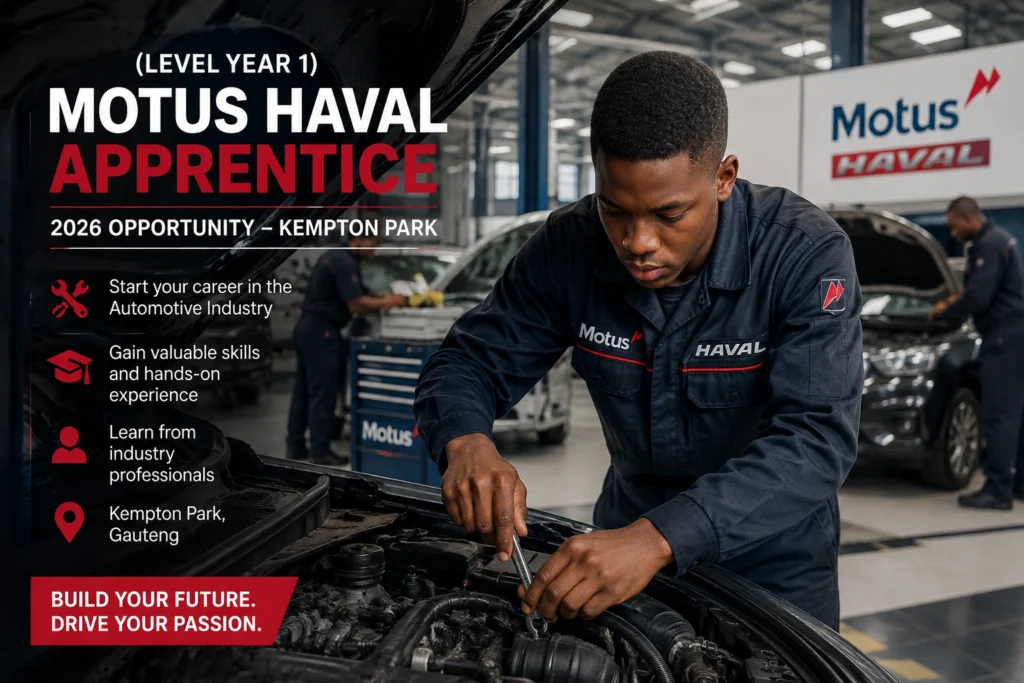
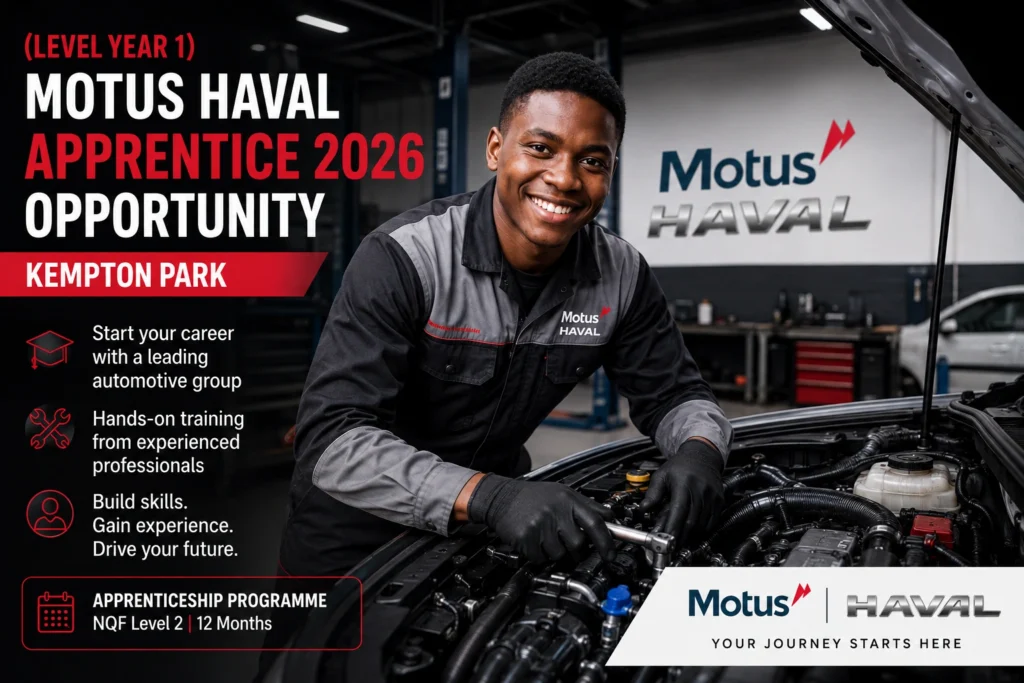
That is what makes the (Level Year 1) Motus Haval Apprentice 2026 opportunity in Kempton Park worth watching.
The position is aimed at an entry-level candidate who is prepared to learn from qualified technicians, work in a real dealership workshop and gradually build the practical habits expected in the motor industry. The opportunity is particularly relevant at a time when vehicle technology is changing quickly and employers increasingly need technicians who can combine traditional mechanical knowledge with diagnostics, electronics and customer-service skills.
The role is based at Motus Haval Kempton Park, at 29 Catalina Avenue, Rhodesfield. Motus currently lists the dealership as one of its Haval locations in South Africa, with sales, service and parts operations.
For applicants, however, there is an important distinction to understand: this is not simply a job where someone spends the day watching technicians work. A genuine apprenticeship is a structured learning pathway, and South Africa’s merSETA framework describes apprenticeships as combining practical and theoretical training towards artisan status.
Why This Opportunity Is Getting Attention
Automotive apprenticeships have always offered an alternative route into a technical career. But the industry entering 2026 looks very different from the one many young mechanics imagined a decade ago.
Modern vehicles increasingly rely on electronic control systems, computerised diagnostics, sensors, hybrid technology and sophisticated driver-assistance features. South Africa’s automotive industry is therefore facing a growing need for technicians who can keep learning rather than relying exclusively on traditional mechanical skills.
That shift is already visible in the training sector. In May 2026, Hyundai Automotive South Africa highlighted the need for advanced technical skills and announced that the new Motus Training Academy in Pinetown would train more than 2,000 students annually in areas including mechatronics, electric-energy vehicles, diagnostics and advanced servicing technologies.
That broader development gives an entry-level apprenticeship more significance.
A Year 1 apprentice is starting at the beginning of the journey, but the skills developed at that stage can form the foundation for a much more technologically demanding automotive career.
What the Motus Haval Apprentice 2026 Opportunity Actually Involves
The description provided for the (Level Year 1) Motus Haval Apprentice 2026 position presents it as a structured introduction to automotive workshop operations.
The successful applicant would learn by participating in practical training while working alongside experienced personnel.
That distinction matters.
An apprentice is expected to learn how things are done correctly, safely and consistently. The early stage is about building competence rather than immediately operating as a fully qualified technician.
The responsibilities include assisting qualified technicians with vehicle diagnosis and repairs under supervision. In practical terms, this could mean learning how technicians inspect vehicles, identify faults, select appropriate tools and follow repair procedures.
The apprentice would also become familiar with workshop organisation.
That might sound less exciting than repairing an engine, but it is an important part of professional automotive work. Tools need to be available and maintained. Parts have to be tracked. Work areas need to remain safe. Vehicles need to be handled carefully.
These are the habits that separate informal mechanical experience from professional workshop competence.
A Role That Goes Beyond Mechanical Repairs
One interesting aspect of this opportunity is the emphasis on customer interaction.
Someone entering an automotive apprenticeship might assume that technical ability is everything. It isn’t.
A dealership workshop is also a customer-service environment.
Customers want to know what is happening to their vehicles. They may need updates about repairs, explanations of delays or assistance with basic queries. An apprentice may not be responsible for making technical decisions independently, but learning how to communicate professionally is valuable.
This combination of technical and interpersonal skills could become increasingly important as vehicles become more complicated.
A technician who can diagnose a fault but cannot communicate clearly with colleagues or customers has an obvious limitation. Conversely, someone who understands the technical process and can explain information accurately becomes more useful to a dealership.
The Requirements: Who Is This Apprenticeship Really For?
The listed requirements are relatively accessible for an entry-level automotive opportunity.
Applicants are expected to have completed high school or hold an equivalent qualification. They should also demonstrate a genuine interest in automotive technology and a willingness to develop practical skills.
The position calls for:
- A completed high school qualification or equivalent
- Interest in automotive technology
- Basic mechanical aptitude
- Good verbal and written communication
- Teamwork and self-motivation
- A proactive approach to problem-solving
- A willingness to learn
- Commitment to quality and safety
- A valid driver’s licence is preferred, but not essential
Previous customer-service or technical experience is described as advantageous rather than mandatory.
That is an important signal for applicants with limited formal work experience.
The strongest candidate may not necessarily be the person with the longest CV. For a Year 1 apprenticeship, the employer also needs someone who can demonstrate potential, discipline and genuine interest in learning.
What Could Give One Applicant an Advantage?
A candidate who has spent time around vehicles may already understand basic components such as brakes, suspension, batteries, engines, transmissions or electrical systems.
That knowledge can help.
So can exposure to automotive tools, technical courses, workshops or practical projects.
But applicants should avoid overstating their ability.
If the position is designed as a Level Year 1 opportunity, nobody should pretend to be an experienced motor mechanic. Instead, the application should show curiosity and evidence that the applicant has already started developing an interest in the field.
For example, mentioning relevant school subjects, technical projects, mechanical hobbies or automotive-related learning can make an application more concrete.
Why This Matters Right Now
The timing is significant because South Africa’s automotive skills requirements are changing.
merSETA identifies motor mechanic apprenticeships as structured technical training pathways, with the Motor Chamber including both time-based and Competence Based Modular Training routes. Its information also identifies motor mechanic training as a four-level pathway.
That means applicants should not think only about the first year.
The bigger question is what skills can be accumulated over several years.
Someone entering at Level Year 1 has an opportunity to establish a foundation in workshop discipline, diagnostics, servicing procedures, parts handling, safety and customer interaction. Over time, these capabilities can become part of a broader artisan-development pathway.
And the technology component is becoming increasingly important.
South Africa is also preparing its automotive industry for greater electric and hybrid vehicle adoption. Government policy discussions in 2026 have included measures connected to electric-vehicle supply chains and local automotive production.
The implication is straightforward: tomorrow’s automotive technician may need to understand far more than engines and mechanical components.
Recent Developments Are Changing the Technician’s Job
The old image of the mechanic working primarily with wrenches and mechanical components is becoming incomplete.
Diagnostics now plays a major role.
Vehicles contain electronic systems that can generate fault codes and provide data about their operation. Technicians increasingly need to understand diagnostic equipment, electrical systems and manufacturer-specific procedures.
Hyundai South Africa’s 2026 training investment is a useful illustration of this shift. Its Motus Training Academy initiative specifically identifies mechatronics, electric-energy vehicles, diagnostics and advanced servicing as areas of training.
For a young apprentice, this creates both a challenge and an opportunity.
The challenge is that the learning curve is becoming wider.
The opportunity is that technical workers who continually update their skills can remain relevant as the industry evolves.
Public Reaction: Why Apprenticeships Continue to Attract Attention
The recurring interest in automotive apprenticeships reflects a broader frustration among young job seekers: many entry-level vacancies ask for experience, while obtaining that first experience can itself be difficult.
That problem is visible in online discussions about mechanical apprenticeships, where prospective artisans regularly describe the challenge of finding employers willing to provide the workplace experience required for progression.
This helps explain why a dealership-based Level 1 opportunity can attract attention.
It provides something that classroom learning alone cannot fully replicate: exposure to an operating workshop.
At the same time, applicants should remain realistic. An apprenticeship is demanding. It involves punctuality, repetitive learning, supervision, safety requirements and accountability.
The attraction should therefore be the career pathway, not simply the prospect of getting a job at a vehicle dealership.
The Traxtion Apprenticeship Reference Needs Careful Attention
There is one detail in the supplied vacancy information that applicants should treat carefully.
The description includes a reference to a “Traxtion apprenticeship program”, even though the rest of the vacancy is clearly framed around Haval Kempton Park and automotive workshop duties.
That wording appears inconsistent with the rest of the opportunity.
Applicants should therefore verify the actual employer, training provider, programme name and application instructions before submitting personal information.
This is particularly important because apprenticeship advertisements can sometimes be reposted or reformatted by third-party job websites.
The safest approach is to cross-check the opportunity against the official Motus recruitment or dealership channels rather than relying exclusively on a reposted advertisement.
Motus officially lists Haval Kempton Park as a dealership at 29 Catalina Avenue, Rhodesfield, Kempton Park.
What Applicants Should Prepare
A serious application should be treated as more than a formality.
Before applying, candidates should prepare a concise CV containing:
- Full contact details
- Matric or equivalent qualification
- Relevant subjects and results
- Technical or automotive studies
- Any work experience
- Customer-service experience
- Practical projects
- Computer or diagnostic exposure, if applicable
- Driver’s licence details, if available
- References where appropriate
Applicants should also check that their contact details are correct.
A surprising number of candidates lose opportunities because employers cannot reach them or because CVs contain outdated information.
APPLY HERE:Motus Haval Apprentice 2026
ALSO APPLY FOR: Motus Toyota Apprentice 2026
What Could Happen Next
There are several possible outcomes for candidates who enter this type of programme.
The first is the most obvious: successful completion of the apprenticeship can contribute to progression towards a recognised automotive trade pathway, subject to the applicable training and assessment requirements.
The second is broader workplace experience.
Even if an apprentice eventually moves to another dealership, workshop or automotive business, experience gained in a structured dealership environment can be useful.
The third is specialisation.
As vehicle technology changes, technicians may increasingly find opportunities in diagnostics, automotive electronics, hybrid systems, electric vehicles and other specialist areas.
That does not mean every apprentice will automatically move into one of these fields. It does mean that the most adaptable learners could have more options than the traditional mechanic career once offered.
How Competitive Could the Opportunity Be?
For a Level Year 1 automotive apprenticeship in a major Gauteng metropolitan area, competition is likely to be high.
The entry requirements are accessible, while the potential value of structured workplace training makes these opportunities attractive to school leavers, technical students and candidates with mechanical interests.
That means simply meeting the minimum requirements may not be enough.
A stronger application will demonstrate preparation.
If two applicants both have matric, the candidate who can clearly explain why they want to become an automotive technician, demonstrate basic mechanical understanding and show evidence of practical interest may stand out.
The Bigger Lesson for Young Automotive Applicants
The (Level Year 1) Motus Haval Apprentice 2026 opportunity should not be viewed simply as another vacancy.
It represents a route into an industry that is itself undergoing a technological transition.
For someone who genuinely enjoys understanding how vehicles work, solving problems and working with their hands, an apprenticeship can offer something that a purely theoretical qualification cannot: the chance to learn inside a functioning workplace.
But the industry is moving.
The technician of the future will need mechanical foundations as well as diagnostic ability, digital confidence, electrical awareness and strong communication.
That is why the best approach is to think beyond the first workshop task.
The real objective is to become the kind of technician who can keep learning as the vehicles themselves change.
And for applicants in Kempton Park who are ready to start at the beginning, that may be the most valuable part of this opportunity.