

Exam preparation has become harder for many students for a reason that has little to do with the difficulty of the subjects themselves: screens are everywhere. A quick break to check WhatsApp can turn into 20 minutes of scrolling. A study session can be interrupted by TikTok notifications, Instagram messages, YouTube recommendations or endless browser tabs. Even when the phone is silent, the temptation to check it can make it difficult to concentrate.
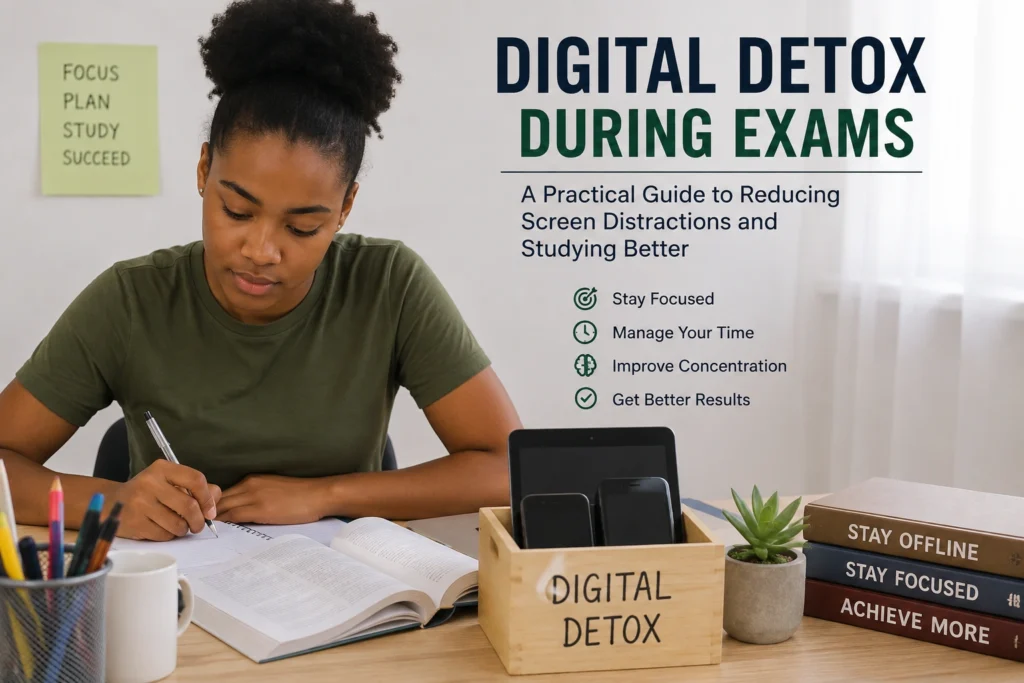
This is where a Digital Detox During Exams can help.
A digital detox does not necessarily mean throwing your phone into a drawer for several weeks or deleting every social media account. Instead, it means deliberately reducing unnecessary digital activity so that your attention, time and mental energy can be directed towards studying, sleeping and recovering.
The goal is not to become completely disconnected. The goal is to become more intentional about technology while exams demand your attention.
What Is a Digital Detox During Exams?
A Digital Detox During Exams is a planned period in which you reduce or control non-essential screen use, particularly activities that interrupt concentration.
This might include:
- Limiting social media use.
- Turning off unnecessary notifications.
- Keeping your phone away while studying.
- Avoiding short-form videos during study breaks.
- Setting specific times to check messages.
- Using website and app blockers.
- Reducing late-night screen use.
- Separating educational technology from entertainment.
The important distinction is between useful screen time and distracting screen time.
If you need your laptop to research an assignment, access an online textbook or attend a virtual lecture, that is not necessarily something you need to eliminate. Similarly, using a calculator app or watching a 10-minute educational explanation may support your preparation.
The problem is uncontrolled digital consumption that repeatedly pulls your attention away from the task.
A successful exam digital detox therefore focuses less on banning technology and more on controlling access to distractions.
ALSO APPLY FOR: Deloitte Bursary 2027
ALSO APPLY FOR: HB & MJ Thom Bursary 2027
Why This Issue Matters
Your attention is one of your most valuable resources during exam season.
When you repeatedly switch between studying and checking your phone, you may feel as though you are multitasking. In reality, you are constantly moving your attention between competing activities.
That can make a two-hour study session far less productive than it appears.
There is also a psychological side to excessive screen use. Social media, messaging platforms and short-form video services are designed to encourage continued engagement. One notification can create a reason to unlock your phone, while one video can lead to another.
During exams, this can create a frustrating cycle:
Study → distraction → phone → scrolling → guilt → rushed studying → stress.
Reducing unnecessary digital stimulation can make it easier to establish longer periods of uninterrupted study.
It can also protect your sleep. Students sometimes study late into the night and then spend another hour scrolling in bed. Losing sleep can leave you tired the following morning, making revision harder.
A digital detox is therefore not simply about improving productivity. It can support a healthier exam routine involving concentration, rest, planning and recovery.
Digital Detox During Exams: Start With a Screen-Time Audit
Before making major changes, find out where your time is actually going.
Check your phone’s screen-time or digital-wellbeing report. Look at the previous seven days if the feature provides that option.
Pay particular attention to:
- Social media.
- Video streaming.
- Short-form video apps.
- Gaming.
- Messaging.
- Web browsing.
- Entertainment apps.
Do not judge yourself based on the number alone. Instead, ask a more useful question:
Which activities are taking time away from studying or sleeping?
For example, three hours of screen time is not necessarily a problem if two of those hours involve online lectures and digital textbooks. Meanwhile, 45 minutes of social media scattered throughout a study day could be highly disruptive.
Once you know your main distractions, you can address them specifically.
Step-by-Step Digital Detox Strategy for Exam Season
1. Decide What You Actually Need Your Phone For
Do not start by saying, “I won’t use my phone at all.”
That approach may be unrealistic, especially if family members need to contact you or you use your phone for educational purposes.
Instead, create two lists.
Essential uses:
- Calls from family.
- Academic communication.
- Authentication codes.
- Educational apps.
- Important reminders.
- Emergency communication.
Non-essential uses:
- Random scrolling.
- Constantly checking messages.
- Watching entertainment videos.
- Browsing social media without a specific purpose.
- Gaming during planned study periods.
Your objective is to reduce the second category while keeping reasonable access to the first.
2. Create Phone-Free Study Blocks
Choose specific periods during which your phone is physically away from you.
For example:
50 minutes studying → 10-minute break → 50 minutes studying.
During the 50-minute blocks, place your phone in another room, inside a bag or somewhere that is inconvenient to reach.
Physical distance matters.
If your phone is sitting beside your textbook, you have to repeatedly resist the temptation to check it. If it is in another room, accessing it requires an extra decision.
That small barrier can make distraction less automatic.
3. Turn Off Non-Essential Notifications
Notifications are interruptions.
You do not need to respond immediately to every message, promotional alert or social-media update.
Keep notifications for genuinely important communication and disable unnecessary alerts.
Consider switching off:
- Social-media notifications.
- Promotional notifications.
- News alerts that are not urgent.
- Game notifications.
- Shopping alerts.
- Unimportant email notifications.
You can check these services at a scheduled time instead.
4. Set Specific Times for Social Media
Instead of repeatedly telling yourself not to use social media, establish a window when you are allowed to use it.
For example:
19:00–19:30: social media and messages.
Outside that period, keep the apps closed.
This can be more sustainable than attempting to eliminate entertainment completely. You still have time to relax and communicate, but your study periods remain protected.
5. Replace Phone Breaks With Real Breaks
A common mistake is using social media as a study break.
You study for 45 minutes, open TikTok “for five minutes” and suddenly 30 minutes have disappeared.
Try alternatives such as:
- Walking around the house.
- Stretching.
- Drinking water.
- Having a snack.
- Looking outside.
- Doing breathing exercises.
- Talking briefly with someone.
- Sitting somewhere away from your desk.
A break should help you recover without creating another attention trap.
6. Make Your Study Environment Boring
This may sound strange, but a simple environment can make concentration easier.
Keep only what you need on your desk.
If you are studying from a computer, close unrelated browser tabs. Put your phone away. Avoid having television playing in the background if it distracts you.
You want your environment to communicate one message:
This is study time.
The fewer competing signals around you, the easier it can be to begin.
7. Use Technology to Fight Technology
You do not have to rely entirely on willpower.
Use built-in screen-time controls, focus modes, app limits and website blockers where appropriate.
For example, you might:
- Block social media during study hours.
- Enable Do Not Disturb.
- Use a website blocker on your laptop.
- Set daily app limits.
- Remove distracting apps temporarily.
- Use a separate browser profile for studying.
The purpose is not to punish yourself. It is to remove unnecessary decisions.
8. Protect Your Sleep
Your digital detox should continue into the evening.
Set a realistic time when entertainment screens are switched off or significantly reduced.
Instead of lying in bed scrolling, prepare for the next day, read printed notes, organise your study materials or simply allow yourself to rest.
Avoid turning sleep into another opportunity for endless screen consumption.
A student who studies for another hour but sleeps poorly may not necessarily be better prepared than someone who stops studying earlier and gets adequate rest.
ALSO READ ABOUT: Free Software Every Graduate Should Install
Best Practices Experts Recommend
A practical digital detox works best when it is specific, realistic and measurable.
Rather than saying, “I need to use my phone less,” create rules you can actually follow.
For example:
“My phone stays outside my study area from 17:00 to 18:00.”
That is much clearer than “I won’t get distracted.”
Another useful principle is to schedule communication rather than constantly monitor it. Friends and family generally do not need an immediate response to every message.
It is also useful to distinguish between active and passive screen use. Writing an assignment, completing an online course or researching an exam topic requires a different type of attention from endlessly consuming entertainment content.
Finally, do not attempt a dramatic detox immediately before an important exam if you have never tried one before. Experiment with shorter phone-free periods first and adjust the system according to what works.
Mistakes People Often Make
Trying to eliminate every screen
Modern studying often requires technology. Completely avoiding screens may make academic work unnecessarily difficult.
Focus on eliminating unnecessary digital activity, not useful technology.
Depending entirely on willpower
If your phone is beside your textbook and every notification is visible, you are creating unnecessary temptation.
Change the environment instead.
Using social media as a reward after every study block
A five-minute social-media break can easily become 30 minutes. Choose rewards that have a natural stopping point.
Staying up late because “there is still so much to study”
Exam stress can make students sacrifice sleep. However, an exhausted study routine is difficult to sustain.
Plan your study time earlier and establish a reasonable stopping point.
Attempting an extreme detox
Deleting every app, refusing all messages and avoiding technology completely may work for some people, but it is not necessary for everyone.
A sustainable system is usually more useful than an extreme one that lasts two days.
Feeling guilty after one bad day
A digital detox is not about achieving perfection.
If you spend an afternoon scrolling, identify what caused it and restart your routine. Do not allow one poor day to turn into an entire unproductive week.
A Simple 7-Day Digital Detox Plan
If you are unsure where to start, try this:
Day 1: Check your screen-time report and identify your biggest distractions.
Day 2: Disable unnecessary notifications.
Day 3: Complete one 45–60-minute phone-free study block.
Day 4: Increase to two phone-free study blocks.
Day 5: Set specific times for checking social media and messages.
Day 6: Keep entertainment apps away from your study environment.
Day 7: Review the week and decide which habits you want to continue.
The objective is not to achieve zero screen time. It is to create a healthier relationship with technology during a demanding academic period.
Frequently Asked Questions
Is a digital detox necessary during exams?
No. It is a strategy, not a requirement. If your phone and computer are already under control, you may not need a formal detox. However, reducing unnecessary digital distractions can be useful if screen use is interfering with concentration, sleep or study time.
Should I delete social media during exams?
Not necessarily. Some students benefit from temporarily deleting distracting apps, while others can manage them using app limits and scheduled access. Choose the approach that you can realistically maintain.
What should I do if I need my phone for studying?
Separate educational use from entertainment. Download necessary materials in advance where possible, use focus modes and keep distracting apps blocked while studying.
How long should a digital detox last?
There is no universal duration. A phone-free study block can be useful for an hour, while a broader reduction in unnecessary screen use can continue throughout the examination period. The best approach is one that fits your academic responsibilities and lifestyle.
Final Summary: Make Your Phone Work for You
A Digital Detox During Exams is not about rejecting technology. It is about preventing technology from controlling your attention at the exact time when concentration matters most.
Start by identifying your biggest distractions. Turn off unnecessary notifications, establish phone-free study blocks, schedule social-media use and create a study environment with fewer interruptions. Most importantly, protect your sleep rather than sacrificing it for additional scrolling or late-night revision.
You do not need a perfect digital routine. You need a practical one that you can repeat every day.
If your phone keeps interrupting your studies, start with one simple change tonight: put it out of reach during your next study session. Once that becomes normal, build from there.
Small reductions in digital distraction can create more uninterrupted time for revision—and during exams, that focused time is often far more valuable than another hour of scrolling.
ALSO APPLY FOR: Deloitte Bursary 2027
ALSO APPLY FOR: HB & MJ Thom Bursary 2027
ALSO READ ABOUT: Free Software Every Graduate Should Install