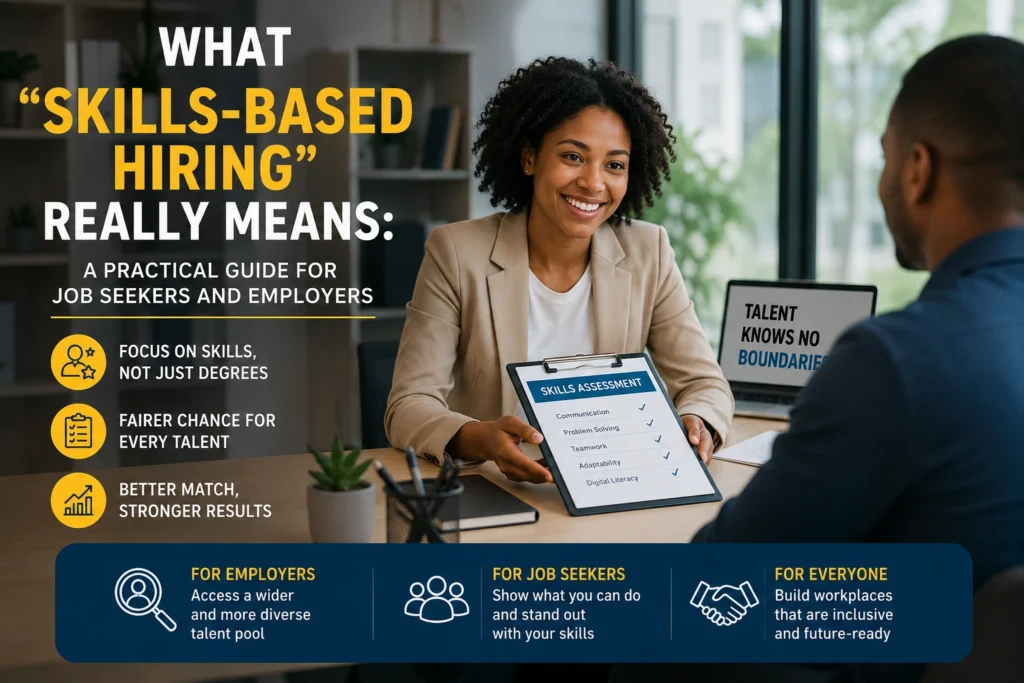

Finding a job can feel confusing when a vacancy lists a degree, several years of experience and a long list of requirements—only for the actual work to depend heavily on practical abilities. At the same time, employers often struggle to identify candidates who can genuinely perform the job rather than simply match keywords on a CV.
This is where skills-based hiring comes in.
Instead of relying primarily on degrees, job titles or traditional career paths, skills-based hiring focuses more closely on what a person can actually do. A candidate may have developed useful skills through formal education, workplace experience, short courses, projects, volunteering, freelancing, apprenticeships or self-directed learning.
But what does this approach actually mean for someone looking for work? Does it mean qualifications no longer matter? Can someone without a university degree compete for professional jobs? And how can applicants prove their skills when an employer asks for evidence?
Understanding what “skills-based hiring” really means can help job seekers position themselves more effectively and help employers make better recruitment decisions.
What Is Skills-Based Hiring?
Skills-based hiring is a recruitment approach in which employers place greater emphasis on a candidate’s demonstrated skills and capabilities rather than treating formal qualifications, previous job titles or conventional career history as automatic requirements.
Traditional recruitment might begin with requirements such as:
- Bachelor’s degree required
- Three years of industry experience
- Previous experience in a similar job
- Specific job title preferred
A skills-based approach asks a slightly different question:
Can this person demonstrate the abilities needed to succeed in the role?
For example, an employer hiring an administrative assistant may care about:
- Microsoft Office proficiency
- Communication
- Data capturing
- Organisation
- Attention to detail
- Customer service
- Time management
A candidate could have developed these abilities through a formal office job, a learnership, an internship, volunteer work or even managing administrative responsibilities for a small organisation.
The important distinction is that skills-based hiring does not necessarily mean qualifications are irrelevant. Some occupations legally or professionally require specific qualifications, registrations or certifications.
Instead, it means employers may be more willing to distinguish between a qualification that is genuinely necessary and one that has simply been included in a traditional job description.
ALSO APPLY FOR: MAS Learnerships 2026
ALSO APPLY FOR: LearnEx Learnership 2026
Why Skills-Based Hiring Is Becoming More Important
The modern labour market is changing quickly. Technology is altering job responsibilities, new occupations are emerging and people increasingly develop skills outside conventional education systems.
Someone might learn digital marketing through online courses and practical projects. Another person might develop coding skills through independent projects. A young South African may gain workplace experience through a learnership or internship before obtaining a permanent position.
This creates a problem with recruitment systems built almost entirely around conventional credentials.
A CV can tell an employer that someone has completed a qualification. It does not automatically prove that the person can solve problems, communicate with customers, analyse information or use a particular software system effectively.
Skills-based hiring attempts to close that gap.
What it does not mean
There are several misconceptions worth clearing up.
It does not mean degrees are useless. A medical professional, engineer or accountant may require recognised qualifications and professional registration.
It does not mean employers should ignore experience. Experience can be valuable evidence that someone has applied their skills successfully.
It does not mean everyone gets hired regardless of ability. Skills still have to be demonstrated.
It does not mean applicants should remove qualifications from their CVs. Qualifications can still strengthen an application, particularly when they are relevant to the position.
The real change is the question employers ask: What evidence shows that this candidate can do the work?
Why This Issue Matters
Skills-based hiring can have a significant real-world impact because traditional recruitment requirements can sometimes exclude capable people before they have an opportunity to demonstrate their abilities.
Consider a young person who has completed a short course in data analysis but has limited formal employment experience. A conventional vacancy requiring several years of experience could automatically exclude that person.
A skills-focused employer might instead assess whether the applicant can:
- Work with spreadsheets
- Clean and organise data
- Identify trends
- Create basic reports
- Explain findings clearly
That creates another route into employment.
For employers, the approach can also widen the talent pool. Instead of searching only for people who followed a specific career path, recruiters can identify candidates who developed relevant capabilities in different ways.
There are also implications for people changing careers.
A former sales employee might possess transferable skills in customer relationship management, communication, negotiation and data analysis that could be useful in another industry.
For South African job seekers, this can be particularly relevant when applying for entry-level jobs, internships, learnerships, apprenticeships and graduate opportunities. Applicants often have limited work experience, making it important to demonstrate what they can do, not simply where they have worked.
How to Approach Skills-Based Hiring as a Job Seeker
If employers are becoming more interested in demonstrable skills, applicants need to change how they present themselves.
Step 1: Read the vacancy for skills, not just qualifications
When you find a vacancy, do not immediately focus on the education requirements.
Look for verbs and responsibilities such as:
- Analyse
- Prepare
- Communicate
- Operate
- Design
- Manage
- Coordinate
- Troubleshoot
- Research
- Record
- Present
These words reveal what the employer expects the successful candidate to actually do.
Create a list of the skills appearing repeatedly in the advertisement.
Step 2: Separate essential skills from desirable skills
Not every requirement carries the same weight.
A vacancy might say:
Required: Excel, customer service and administration.
Advantageous: Experience with a particular CRM system.
This distinction matters.
If you do not have the advantageous requirement but meet the essential skills, you should not automatically reject yourself.
Likewise, if a requirement is legally mandatory, do not assume that transferable skills can replace it.
Step 3: Identify evidence for every important skill
This is where many applicants struggle.
Simply writing “good communication skills” on a CV provides little evidence.
Instead, think about where you have demonstrated the skill.
For example:
“Used Excel to capture and organise weekly sales information during an internship.”
That is much stronger because it connects the skill to an activity.
Evidence can come from:
- Employment
- Internships
- Learnerships
- Apprenticeships
- Academic projects
- Volunteer work
- Freelance work
- Personal projects
- Student societies
- Community activities
The key is honesty. Never invent experience to make your CV appear stronger.
Step 4: Build a skills-focused CV
Your CV should make relevant capabilities easy to find.
For example, instead of having a generic skills section containing twenty unrelated items, prioritise the skills that match the vacancy.
A technical candidate might highlight:
Technical skills: AutoCAD, technical drawings, Excel, equipment maintenance and basic troubleshooting.
A customer-service applicant could prioritise:
Customer-facing skills: Communication, complaint handling, point-of-sale systems, problem solving and record keeping.
This makes the CV easier for both recruiters and applicant-tracking systems to interpret.
Step 5: Create evidence outside your CV
Where appropriate, build a small portfolio.
A portfolio could contain:
- Coding projects
- Graphic designs
- Writing samples
- Data dashboards
- Engineering projects
- Research assignments
- Marketing campaigns
- Presentations
- Technical drawings
Not every profession requires a formal portfolio, but evidence can make an abstract claim about your ability much more credible.
Step 6: Prepare for skills-based assessments
Some employers may use practical assessments during recruitment.
Instead of asking only interview questions, they might ask candidates to:
- Complete an Excel task
- Analyse a scenario
- Write an email
- Solve a technical problem
- Present an idea
- Complete a coding exercise
- Respond to a simulated customer complaint
Preparation should therefore go beyond memorising interview answers.
Practise doing the actual work.
ALSO READ ABOUT: The Rise of Micro-Credentials
How Employers Can Implement Skills-Based Hiring
Skills-based hiring is not only an applicant strategy. Employers need to design the recruitment process differently.
First, organisations should identify the capabilities genuinely required for successful performance.
Then they should distinguish between:
Must-have requirements — skills or credentials genuinely necessary to perform the job.
Trainable skills — capabilities that a suitable candidate could reasonably learn after appointment.
Nice-to-have requirements — characteristics that improve an application but are not essential.
This can prevent unnecessarily restrictive job advertisements.
Employers should also use assessments that measure relevant abilities. If a role requires analytical thinking, an appropriate work sample may provide better evidence than simply asking whether someone considers themselves analytical.
Structured interviews can also improve consistency. Candidates can be asked the same core questions and evaluated against predetermined criteria.
Best Practices Experts Recommend
A practical skills-based recruitment system should focus on evidence rather than assumptions.
Define skills clearly
“Good communication” is vague. Employers should identify what communication means in the specific position.
Does the employee need to write reports, communicate with customers, make presentations or explain technical information?
Use realistic assessments
Assess candidates using tasks that resemble the actual job wherever possible.
Consider transferable skills
Career changers may have valuable capabilities developed in another industry.
Keep qualifications where they genuinely matter
Skills-based hiring should not become an excuse to ignore professional, legal or safety requirements.
Give applicants opportunities to demonstrate ability
If someone does not have a conventional background, a practical assessment can provide a fairer opportunity to show competence.
Review job descriptions regularly
Technology and workplace responsibilities change. A requirement that was useful several years ago may no longer be necessary.
Mistakes People Often Make
Treating skills-based hiring as “no qualifications required”
This is one of the biggest misunderstandings.
Some jobs have mandatory educational, professional or regulatory requirements. Applicants should always check the actual requirements of the occupation.
Listing skills without evidence
Writing “leadership”, “teamwork” and “problem solving” does not prove anything by itself.
Whenever possible, connect a skill to a real achievement or responsibility.
Applying for jobs without the core skills
Skills-based hiring does not mean applying for every vacancy.
If a position requires a specific technical capability that you genuinely do not have, it may be better to develop that skill before applying.
Ignoring transferable experience
People sometimes assume that experience only counts when it comes from the exact same industry.
That is not necessarily true.
Customer service, administration, project coordination, communication, research and digital skills can transfer across many workplaces.
Inflating your abilities
There is a difference between being familiar with a tool and being proficient in it.
If an employer tests the skill, exaggeration can quickly become obvious.
Frequently Asked Questions
Does skills-based hiring mean degrees no longer matter?
No. Qualifications remain essential for many careers and can still be an important selection factor. Skills-based hiring simply encourages employers to assess whether qualifications are genuinely necessary and to consider demonstrated capabilities alongside credentials.
Can someone without work experience benefit from skills-based hiring?
Yes. School projects, internships, learnerships, volunteering, personal projects and practical training can provide evidence of skills. The important thing is to explain what you actually did and what capabilities you developed.
How can I prove my skills on a CV?
Use specific examples rather than unsupported claims. Describe the task you completed, the tools you used and, where possible, the result. A portfolio or work sample can provide additional evidence for suitable occupations.
Is skills-based hiring better than traditional hiring?
It can be more useful when traditional requirements unnecessarily exclude capable candidates. However, the best recruitment process depends on the occupation. A balanced approach can consider qualifications, experience, skills and evidence of performance.
Final Summary: Focus on What You Can Demonstrate
Understanding what “skills-based hiring” really means is ultimately about understanding the difference between possessing a credential and demonstrating capability.
For job seekers, the lesson is straightforward: do not build your entire application around qualifications and job titles. Identify the skills the employer actually needs, then provide credible evidence that you can use those skills.
For employers, the lesson is equally important: do not automatically treat a degree, years of experience or previous job title as a perfect substitute for competence.
The most useful approach is to connect requirements, skills and evidence.
If you are searching for work, start with your next vacancy. Highlight the five to ten most important skills mentioned in the advertisement. For each one, identify a genuine example from your education, work, training, volunteering or personal projects. Then update your CV so those examples are clear.
That simple exercise can make your application more focused—and help you approach the changing world of recruitment with a much better understanding of what employers are actually looking for.
ALSO APPLY FOR: MAS Learnerships 2026
ALSO APPLY FOR: LearnEx Learnership 2026
ALSO READ ABOUT: The Rise of Micro-Credentials