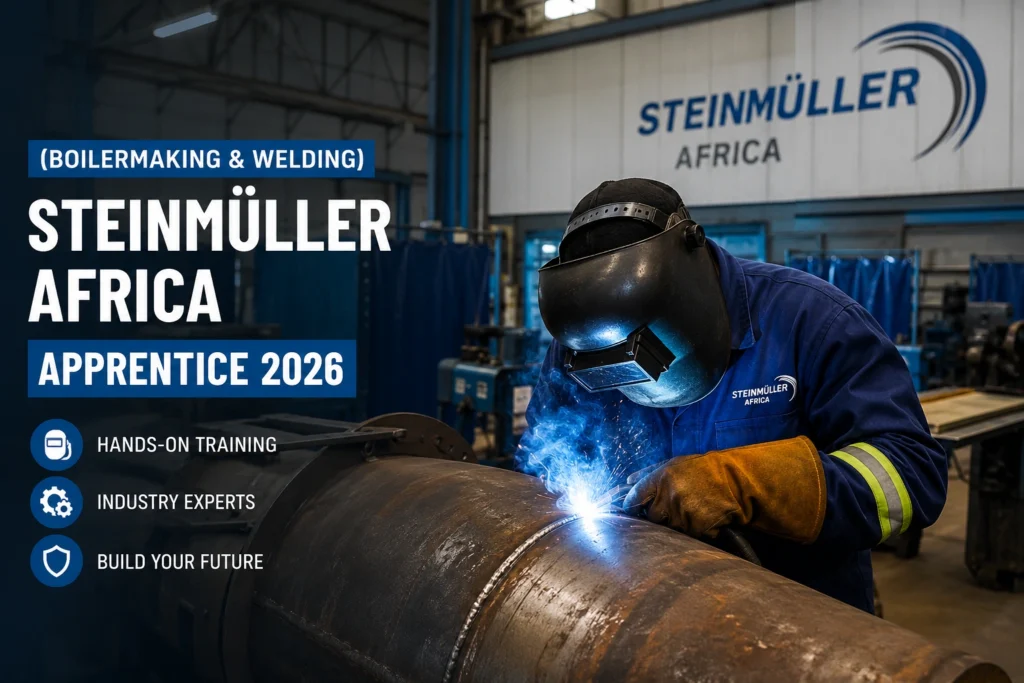

For young South Africans trying to break into skilled technical careers, opportunities that combine structured training with real workplace exposure can be difficult to find. That is why the (Boilermaking and Welding) Steinmüller Africa Apprentice 2026 programme is attracting attention now.
Steinmüller Africa has opened applications for boilermaking and welding apprenticeships in Bethal, Mpumalanga, with the training expected to run for a minimum of 36 months. Applications close on 14 August 2026.
On paper, the opportunity looks straightforward: Grade 12, the right Mathematics and Science subjects, an age limit of 35, physical fitness and a willingness to complete intensive artisan training.
But there is more to consider.
The residential requirement, lack of advertised accommodation and transport, and the fact that no stipend has been announced make this an opportunity that applicants need to assess carefully rather than simply apply for because the word “apprenticeship” appears in the headline.
The bigger story behind the Steinmüller Africa apprenticeship
South Africa’s artisan shortage has made technical training increasingly important. Boilermakers and welders are among the skilled workers needed across industrial, engineering, manufacturing, construction and energy-related environments.
Yet getting from school to an actual artisan career is not always easy.
A matric certificate alone does not provide the practical competence required for many technical occupations. This is where apprenticeships become valuable. They create a bridge between classroom-based knowledge and the practical workplace.
The Steinmüller Africa programme follows that model.
Rather than offering a short course that ends after a few weeks or months, the apprenticeship is structured around theoretical learning, practical training and workplace experience over at least three years.
For an unemployed young person who is serious about becoming an artisan, that length is significant.
It also means the commitment is significant.
What the 2026 programme actually offers
The apprenticeship is aimed at candidates interested in either boilermaking or welding.
Although the two trades overlap in their use of metal and industrial equipment, they are not identical careers.
A boilermaker typically works with metal fabrication, structural components, industrial equipment and the assembly or repair of metal structures. Welding, meanwhile, focuses heavily on joining metals using appropriate welding processes and techniques.
The training is therefore not simply about learning how to use workshop equipment.
Apprentices are expected to develop technical knowledge, practical competence, workplace discipline and an understanding of industrial safety.
The programme will involve:
- Theoretical and knowledge modules
- Practical workshop training
- Supervised workplace experience
- Tasks assigned by mentors or training personnel
- Exposure to operational or production environments
- Preparation for the relevant trade test
- Completion of prescribed apprenticeship requirements
The ultimate goal is artisan qualification after the required training has been completed and the applicable trade test has been passed.
That distinction matters.
Being accepted into an apprenticeship is not the same as becoming a qualified artisan. The trade test remains a critical part of the journey.
Why the 36-month commitment matters
Three years can sound like a long time when you are unemployed and looking for your first opportunity.
But artisan development is not supposed to be a quick process.
Technical competence requires repetition. Apprentices need time to understand theory, practise techniques, work under supervision and gradually become more confident in an industrial environment.
The Steinmüller Africa apprenticeship therefore demands patience.
Candidates should not approach it as a temporary placement designed simply to add something to a CV. They should approach it as a career-building programme.
Attendance, discipline and the ability to learn from mistakes are likely to matter just as much as academic performance once practical training begins.
Who qualifies for the Steinmüller Africa Apprentice 2026 programme?
The advertised requirements make this opportunity particularly relevant to unemployed young people who already have a technical foundation from school.
Applicants must generally:
- Be unemployed
- Be 35 years old or younger
- Have completed Grade 12
- Meet the required Mathematics and Science requirements
- Have the required minimum marks
- Be physically and medically fit
- Have a clear criminal record
- Provide valid proof of residence
- Meet the programme’s residential requirements
- Be willing to relocate at their own cost if necessary
Previous work experience has not been identified as a requirement.
That is important for school leavers and other unemployed candidates who may have the academic foundation but lack formal industrial experience.
The programme is, after all, designed to develop apprentices.
The Mathematics requirement could eliminate some applicants
One of the most important details is the subject requirement.
Applicants need English, together with either Mathematics or Technical Mathematics, and either Physical Science or Technical Science.
The required subjects must reportedly have a minimum mark of 50%.
There is also a crucial distinction that applicants should not overlook:
Mathematical Literacy is not accepted as a substitute for Mathematics or Technical Mathematics.
This means someone who has Grade 12 but completed Mathematical Literacy should not assume that having matric automatically makes them eligible.
Applicants should check their actual matric certificate before beginning the application.
Engineering Graphics and Design may also be advantageous because the subject can provide useful exposure to technical drawings, measurements and engineering concepts.
It is not a replacement for the compulsory subjects, but it can be relevant preparation for technical training.
The residential requirement changes the equation
For many applicants, this could be the most important practical issue.
The apprenticeship will be based in Bethal, Mpumalanga, but Steinmüller Africa has specified a residential requirement connected to certain power-station areas.
Candidates are expected to live within a 50-kilometre radius of one of the listed power stations:
- Arnot
- Camden
- Duvha
- Hendrina
- Kendal
- Kriel
- Kusile
- Majuba
Candidates who do not currently live within the required areas need to be prepared to relocate.
And there is an important financial catch.
Accommodation and transport will not be provided by the company.
For an unemployed applicant, that can make the difference between being technically eligible and realistically able to participate.
Before applying, candidates should therefore calculate the cost of getting to Bethal, finding accommodation if necessary and travelling during the training period.
An apprenticeship can be a valuable investment in your career, but applicants should not ignore the cost of getting through the training.
What are applicants likely to do during training?
The daily reality of an apprenticeship is considerably different from sitting in a classroom.
Successful candidates can expect a combination of learning, practical work and supervised workplace responsibilities.
They may spend time studying technical concepts, working in workshops, completing assigned practical tasks and learning how industrial operations function.
Safety will also be central.
Boilermaking and welding involve potentially hazardous equipment, high temperatures, machinery and industrial environments. Apprentices therefore need to take safety instructions seriously from the beginning.
Being technically capable is only part of becoming a reliable artisan.
Employers also need people who arrive on time, follow instructions, communicate with colleagues, protect equipment and recognise when a task must be stopped because it is unsafe.
Public reaction: opportunity meets practical reality
The strongest appeal of the programme is obvious: it gives unemployed young people a potential route into skilled employment without requiring years of university study before entering practical training.
That is particularly relevant in a labour market where many young people leave school with qualifications but struggle to secure their first meaningful workplace opportunity.
At the same time, the programme’s conditions create a more complicated picture.
The absence of an advertised stipend means applicants should not automatically expect a monthly allowance. Similarly, candidates should not assume that accommodation or transport will be supplied simply because the programme is an apprenticeship.
That is where responsible career advice becomes important.
The right question is not simply, “Can I apply?”
It is also:
“Can I realistically complete the programme under these conditions?”
Why This Matters Right Now
The timing of the Steinmüller Africa apprenticeship is significant because technical skills remain an important route into industrial careers.
South Africa needs workers who can operate, maintain, fabricate, repair and support complex industrial systems. Artisan development can provide young people with a pathway that is more directly connected to practical occupations than many purely academic routes.
For applicants, the potential benefit goes beyond the apprenticeship itself.
A successfully completed artisan pathway can provide a foundation for future work in industrial maintenance, fabrication, engineering-related environments, construction, manufacturing and other technical sectors, depending on the individual’s qualification and experience.
But the programme also highlights a wider issue: access to training is only useful when candidates can afford to participate.
Transport and accommodation costs can create barriers for unemployed applicants, particularly those who live far from the training location.
That makes financial planning part of the application process.
The qualities that could separate strong candidates
Meeting the minimum requirements gets an applicant into consideration. It does not guarantee selection.
Candidates should demonstrate qualities that make sense for a demanding technical environment.
These include being:
- Task-oriented
- Self-driven
- Detail-conscious
- Comfortable working with others
- Willing to follow technical instructions
- Safety-conscious
- Reliable
- Committed to completing the full apprenticeship
Technical training can involve repetition and difficult assessments. People who expect immediate results may become discouraged.
Those who understand that competence develops gradually are likely to be better prepared for the demands of the programme.
Documents applicants should prepare
Candidates should prepare their documentation before starting the online application.
A useful checklist includes:
- Updated CV
- Certified copy of ID
- Certified Grade 12 certificate
- Valid proof of residence
- Relevant technical certificates, where applicable
- Other supporting qualifications, if available
Applicants should ensure that their personal information is consistent across documents.
This is particularly important because of the residential requirement.
If the address on the application differs substantially from the proof of residence, the discrepancy could create questions during screening.
Do not submit documents that are blurry, incomplete or difficult to read.
How to apply for the Steinmüller Africa apprenticeship
Applications must be submitted online through the official Steinmüller Africa application portal.
The closing date is 14 August 2026.
Applicants should:
- Confirm that they meet the age, academic and employment requirements.
- Check their Grade 12 certificate for Mathematics or Technical Mathematics and the required Science subject.
- Confirm that their marks meet the stated minimum.
- Review the residential requirement carefully.
- Decide whether boilermaking or welding best matches their interests.
- Prepare a current CV and supporting documents.
- Complete the online application accurately.
- Upload the required documents in the requested format.
- Review every field before submitting.
- Save the confirmation or application reference after submission.
Do not leave the application until the final day.
Technical problems, document-upload errors or internet interruptions can turn a straightforward application into a missed opportunity.
APPLY HERE: Steinmüller Africa Apprentice 2026
ALSO APPLY FOR: Fancourt Golf Course Apprentice 2026
What Could Happen Next
The next stage is likely to involve the employer reviewing applications against the stated eligibility and selection requirements.
Candidates should therefore keep their phones and email accounts accessible after applying and monitor the contact details provided in their application.
Those selected for further consideration may need to demonstrate that their academic information, residence and other eligibility details are accurate.
The longer-term outcome will depend heavily on the apprentices themselves.
Some candidates will progress through the theoretical and practical stages and eventually attempt the relevant trade test. Others may discover that industrial training is more demanding than expected.
There is also a broader possibility.
Programmes like this can help strengthen the pipeline of young artisans entering South Africa’s technical workforce. But their impact depends on completion, successful trade-test outcomes and whether qualified apprentices can eventually transition into sustainable employment.
In other words, the real measure of success will not be how many people apply.
It will be how many develop into competent artisans.
A final reality check for applicants
The Steinmüller Africa Apprentice 2026 opportunity deserves attention, but it should be approached with clear eyes.
This is not a short training course. It is a minimum 36-month commitment involving theory, practical development, workplace exposure and trade-test preparation.
The opportunity is potentially valuable for an unemployed young person who wants to pursue boilermaking or welding and already meets the academic requirements.
But the practical conditions matter.
There is no advertised stipend at the time of the opportunity announcement, and accommodation and transport are not being provided. Applicants who need to relocate must therefore understand the financial commitment before accepting a place.
For candidates who meet the requirements and can manage those realities, however, the programme offers something difficult to put a price on: structured exposure to a real technical career.
The application deadline is 14 August 2026.
The best applicants will not simply be those who click “apply” first. They will be the ones who understand what they are signing up for—and are prepared to see the apprenticeship through.