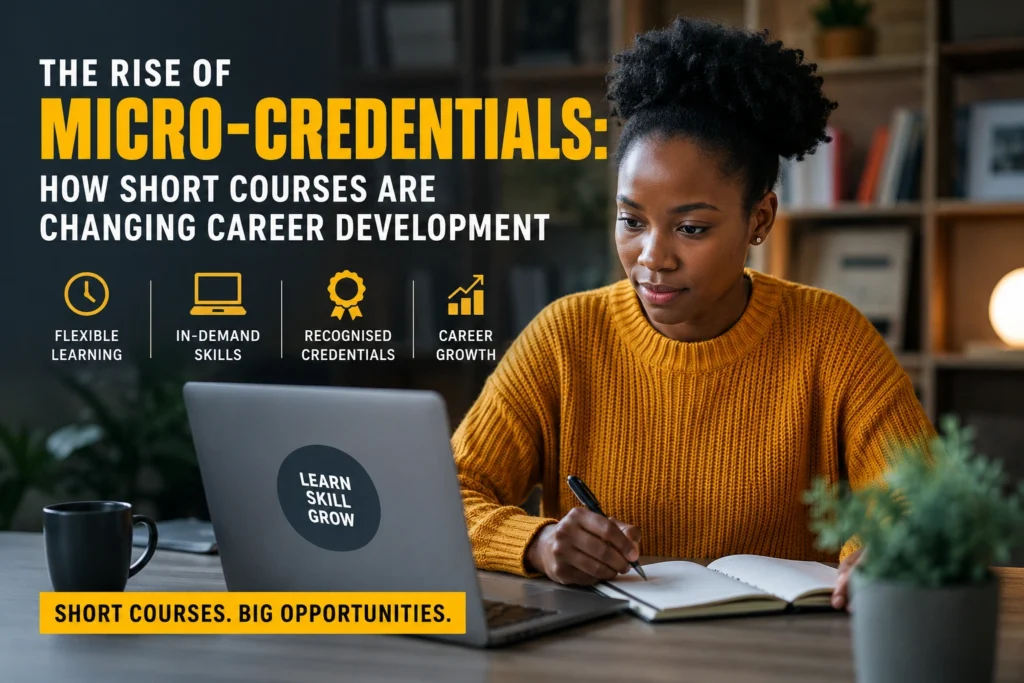

For many job seekers, the traditional path from school to a qualification and then into employment is becoming harder to navigate. A degree can take several years, while employers increasingly want evidence that candidates can use specific tools, technologies and workplace skills right now. At the same time, professionals already in employment may not have the time or money to return to university whenever their industry changes.
This is one reason the rise of micro-credentials has attracted growing attention. Instead of committing to a long qualification, learners can complete shorter, focused programmes designed around a particular skill or competency.
Micro-credentials are not a magic replacement for degrees, diplomas or occupational qualifications. Their value depends heavily on the quality of the provider, the credibility of the assessment and whether employers recognise the skills being demonstrated.
For students, graduates, career changers and working professionals, however, they can provide a practical way to build skills incrementally and demonstrate continuous learning.
What Are Micro-Credentials?
A micro-credential is a relatively short learning programme that focuses on a specific skill, competency or area of knowledge.
Unlike a traditional qualification covering a broad curriculum, a micro-credential usually has a narrower purpose. For example, someone might complete a credential focused on:
- Data analytics
- Digital marketing
- Project management
- Cybersecurity fundamentals
- Cloud computing
- Artificial intelligence
- Microsoft Excel
- Financial modelling
- Coding
- Business communication
- Workplace leadership
The format can vary considerably. Some micro-credentials are delivered online, while others are offered by universities, colleges, professional bodies, technology companies or training organisations.
Importantly, not every online certificate should automatically be considered a valuable micro-credential.
A credible programme should make it reasonably clear what the learner has learned, how competence was assessed and who issued the credential.
This distinction matters because the internet is full of short courses. Completing a two-hour video course and receiving a certificate is not necessarily equivalent to completing a structured programme involving assignments, practical assessment and demonstrated competency.
ALSO APPLY FOR: P&G Summer Internship 2027
ALSO APPLY FOR: Synthesis Graduate Intern 2027
The Rise of Micro-Credentials Is Changing How People Learn
Traditional education often follows a linear model: finish school, obtain a qualification, enter the workforce and gradually build experience.
Modern careers are less predictable.
Technology changes rapidly. New software platforms appear. Businesses introduce new roles. Some occupations require employees to update their knowledge every few years.
Micro-credentials fit this environment because they allow learning to become more modular.
Instead of asking, “What qualification do I need for the next five years?”, a learner can ask:
“What specific skill would make me more capable or employable in the next six months?”
That does not make traditional education irrelevant. Rather, it creates another layer of learning that can sit alongside degrees, diplomas, workplace experience and professional development.
For example, someone studying business administration might add credentials in Excel, data analysis and project management. Those smaller learning achievements could help demonstrate a more specific skill set than the broad qualification alone.
Why This Issue Matters
The growth of micro-credentials matters because the gap between having a qualification and being able to demonstrate a practical skill can be significant.
A qualification tells an employer something about a person’s education. A relevant micro-credential can potentially provide additional evidence of specific capabilities.
This can be particularly useful in fields where tools and processes change quickly.
Consider a graduate applying for an entry-level data-related role. Their degree may demonstrate academic knowledge, but an additional credential in a relevant analytics platform could show that they have deliberately developed a practical skill.
There is also an accessibility argument.
A full qualification may require substantial financial investment, several years of study and a significant time commitment. A shorter programme can sometimes be completed while a person is working or studying something else.
For unemployed people, micro-credentials can also provide a structured way to keep learning while searching for employment. However, applicants should avoid accumulating certificates simply for the sake of having more documents.
Relevance matters more than quantity.
Who Can Benefit From Micro-Credentials?
Micro-credentials can be useful for several groups.
Students
Students can use them to complement their formal studies with practical skills.
A computer science student, for instance, might pursue a credential in cloud computing or a particular programming technology.
Graduates
Graduates can use targeted learning to strengthen gaps between their academic background and entry-level job requirements.
Working Professionals
Employees may use micro-credentials to update their skills without leaving employment for full-time study.
Career Changers
Someone moving into a new field can use carefully selected credentials to demonstrate initial exposure to the skills required by that industry.
Small Business Owners and Entrepreneurs
Business owners may use short programmes to develop practical knowledge in areas such as digital marketing, bookkeeping, project management or data analysis.
How to Use Micro-Credentials Strategically
The biggest mistake is starting with the certificate instead of starting with the career goal.
Here is a more effective approach.
Step 1: Identify the Skill Gap
Look at job advertisements for positions you genuinely want.
Do not only look at the qualification requirements. Examine the recurring skills.
For example, you might notice that several entry-level vacancies request:
- Advanced Excel
- Power BI
- Data analysis
- Customer relationship management software
- Project management
- Digital marketing
This gives you a more useful starting point than randomly searching for certificates.
Step 2: Separate Essential Skills From Nice-to-Have Skills
Not every skill mentioned in a job advertisement deserves equal attention.
Identify the skills that appear repeatedly across employers.
If five relevant vacancies mention Excel and only one mentions a particular software platform, Excel may deserve priority.
Your goal should be to build a coherent skills profile rather than collect unrelated credentials.
Step 3: Research the Provider
Before paying for a programme, investigate who is offering it.
Check:
- Who issues the credential?
- What does the course actually cover?
- Is there an assessment?
- How long does completion normally take?
- Is the credential verifiable?
- Do employers or professional organisations recognise it?
- Are the learning outcomes clearly stated?
- Is the provider transparent about costs?
Be particularly cautious when a provider makes unrealistic claims about guaranteed employment or dramatically higher salaries.
Step 4: Check Whether the Credential Is Relevant
A prestigious-looking certificate has limited value if it does not relate to the role you want.
Ask yourself:
“Would this credential help an employer understand why I am suitable for the position?”
If the answer is no, reconsider the investment.
Step 5: Choose Programmes That Require Evidence of Learning
Whenever possible, prioritise programmes that involve practical work.
A credential supported by a project, assessment or portfolio can give you something tangible to discuss during an interview.
For example, instead of simply saying you completed a data analytics course, you could demonstrate a small analysis project and explain the methods you used.
That is much more useful evidence of learning.
Step 6: Build a Skills Portfolio
Don’t let your credential become a line on your CV that nobody can verify or understand.
Keep examples of your work.
Depending on the field, this could include:
- A data dashboard
- A marketing campaign
- A coding project
- A financial model
- A project plan
- A presentation
- A research report
- A cybersecurity lab exercise
Your portfolio gives practical context to your learning.
Step 7: Add the Credential Correctly to Your CV
Don’t create a huge list of certificates.
Instead, select the credentials most relevant to the job.
Include the credential name, issuing organisation and completion date where appropriate. If the credential demonstrates a specific technical competency, make that skill visible in the relevant skills section.
The objective is to make your CV easier for a recruiter to understand, not longer.
ALSO READ ABOUT: Can You Build a Career Without Going to University
The Rise of Micro-Credentials: What Employers Should Look For
Employers also have an important role to play.
If companies want skills-based hiring to become more effective, they need to distinguish between meaningful credentials and certificates that provide little evidence of competence.
Recruiters should consider:
- The reputation of the issuing organisation
- The learning outcomes
- Assessment requirements
- Practical components
- Credential verification
- Recency of the skill
- Relevance to the position
A credential should be treated as one piece of evidence, rather than automatic proof that someone is highly competent.
Work samples, interviews, references and actual experience remain important.
Best Practices Experts Recommend
A sensible micro-credential strategy is based on quality and relevance.
Start with the job market. Research actual vacancies before selecting a course.
Prioritise recognised providers. Credentials from established educational institutions, professional organisations or respected technology companies may carry more weight than unknown certificates.
Choose assessment-based learning. A programme requiring learners to demonstrate competence can be more meaningful than passive video completion.
Connect learning to projects. Whenever possible, turn what you learn into something you can show.
Keep your credentials current. A technology credential can lose relevance if the underlying platform or industry practice changes substantially.
Avoid certificate collecting. Ten unrelated certificates may be less useful than two carefully selected credentials connected to your career objective.
Combine credentials with experience. The strongest profile often combines formal education, practical experience, targeted learning and demonstrable work.
Mistakes People Often Make
One of the biggest mistakes is assuming that every certificate has equal value.
It doesn’t.
Another common problem is choosing courses because they are cheap or easy rather than because they address a genuine skills gap.
Some learners also complete courses without doing anything practical afterwards. This means they may remember very little when an employer asks them to apply the skill.
Another mistake is putting every certificate on a CV. Recruiters do not necessarily need to see a long catalogue of short courses. A carefully selected list is easier to evaluate.
Finally, some people expect micro-credentials to replace experience immediately. They generally cannot.
A credential can strengthen a candidate’s profile, but it does not automatically create professional experience.
Are Micro-Credentials Worth Paying For?
The answer depends on the credential.
Before spending money, calculate the potential value.
Consider the cost, time commitment, quality of the provider and relevance to your target career.
A relatively inexpensive credential that teaches a frequently requested workplace skill may be worthwhile.
A costly programme with vague learning outcomes and little employer recognition may not be.
Free options can also be useful, but “free” does not automatically mean “valuable.” The same quality checks should apply.
Frequently Asked Questions
Are micro-credentials the same as degrees?
No. Micro-credentials are generally narrower and shorter than degrees. They are designed to demonstrate specific skills or competencies rather than provide broad academic education
Can micro-credentials help me get a job?
They can strengthen an application, particularly when the credential relates directly to the job requirements. However, employment decisions also depend on qualifications, experience, practical ability, communication skills and the employer’s requirements.
Should students collect as many micro-credentials as possible?
No. A smaller number of relevant, credible credentials is usually more useful than a large collection of unrelated certificates.
Are online certificates always recognised by employers?
No. Recognition varies significantly. Before enrolling, investigate the provider, assessment process, industry relevance and whether employers in your target field value the credential.
The Future of Skills-Based Learning
The rise of micro-credentials reflects a broader change in education and employment: people increasingly need ways to update specific skills without necessarily starting an entirely new qualification.
That does not mean universities, colleges and traditional qualifications are disappearing. Instead, learning is becoming more flexible.
Someone might complete a degree, gain workplace experience, take a short professional course, earn a technology credential and later pursue another qualification. These pieces can build a broader professional profile over time.
For job seekers, the most important lesson is simple: don’t pursue credentials merely because they look impressive. Pursue skills that solve a real career problem.
Start by identifying the roles you want. Study their requirements. Find the skills you are missing. Choose reputable learning providers. Complete programmes that genuinely assess your knowledge. Then turn what you learned into practical evidence.
A micro-credential is most valuable when it represents something you can actually do.
Final Summary and Practical Advice
The Rise of Micro-Credentials is not simply about collecting more certificates. It represents a shift towards shorter, targeted and skills-focused learning.
For learners, the opportunity is to become more deliberate about professional development. Instead of spending time and money on every available course, focus on credentials that connect directly to your career goals.
Before enrolling in your next programme, ask yourself five questions:
- What skill will I gain?
- Is that skill actually requested by employers?
- Who is issuing the credential?
- Will I have to demonstrate what I learned?
- Can I turn the learning into practical evidence?
If you can answer those questions confidently, a micro-credential may be a worthwhile addition to your career development plan.
The strongest strategy is not more certificates. It is better evidence of relevant skills.
ALSO APPLY FOR: P&G Summer Internship 2027
ALSO APPLY FOR: Synthesis Graduate Intern 2027
ALSO READ ABOUT: Can You Build a Career Without Going to University