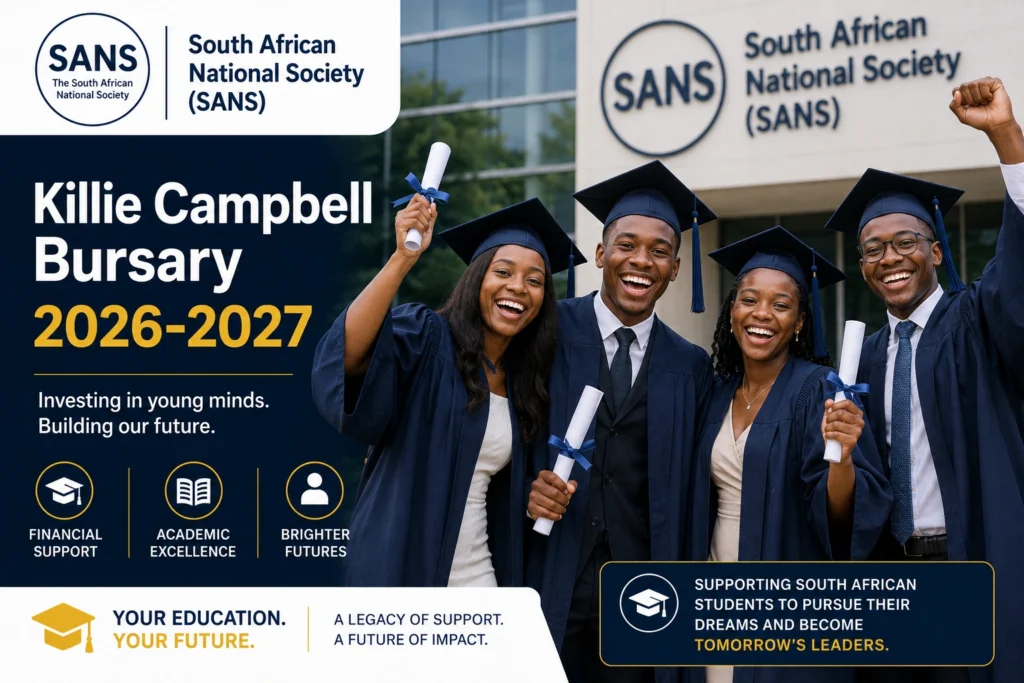

The South African National Society (SANS) Killie Campbell Bursary 2026-2027 offers an excellent opportunity for postgraduate students who want to contribute to the understanding of South Africa’s rich historical heritage. Research at Honours, Master’s, and Doctoral level often requires significant financial support, especially when students need to travel, access archives, purchase research materials, or dedicate time to writing a dissertation or thesis.
This bursary was established to encourage historical research focused on South Africa, while giving particular consideration to studies exploring the history of KwaZulu-Natal. Although the award is relatively modest compared to full postgraduate funding, it can make a meaningful difference in helping researchers complete high-quality academic work.
If you’re considering postgraduate studies in History or are already conducting historical research, understanding how this bursary works can improve your chances of submitting a strong application before the 31 July 2026 deadline.
What You Should Know First
The South African National Society (SANS) Killie Campbell Bursary 2026-2027 is:
- A postgraduate research bursary
- Intended for Honours, Master’s, and Doctoral students
- Focused on South African historical research
- Especially supportive of KwaZulu-Natal history topics
- Worth approximately R25,000
- Open to students studying at accredited South African universities
- Applied for through a document-based submission rather than an online application form
Unlike many bursaries that simply ask for an online application, this opportunity requires applicants to prepare a carefully structured research submission demonstrating academic merit and a well-developed research proposal.
Understanding the SANS Killie Campbell Bursary
The South African National Society (SANS) established this bursary to encourage serious historical scholarship while honoring the legacy of Dr Killie Campbell, one of South Africa’s most respected historians and collectors.
Dr Campbell devoted much of her life to preserving documents, manuscripts, photographs, maps, and historical records relating to South Africa. Today, her famous Africana collection forms part of the University of KwaZulu-Natal’s valuable historical archives.
Rather than rewarding academic performance alone, this bursary aims to support research that expands knowledge of South African history and contributes meaningful scholarship for future generations.
Who Is the South African National Society?
The South African National Society has a long history of promoting appreciation for South Africa’s:
- Historical heritage
- Cultural heritage
- Natural heritage
Its work encourages research, education, preservation, and public understanding of the country’s diverse historical development.
By funding postgraduate researchers, the society helps ensure that important historical stories continue to be documented and studied.
Why Historical Research Still Matters
Some people assume History only focuses on events from the distant past. In reality, historical research helps explain many issues that continue shaping South Africa today.
Examples include:
- Land ownership history
- Community development
- Cultural identity
- Colonial administration
- Liberation movements
- Traditional leadership
- Urban development
- Heritage conservation
Understanding these topics helps academics, policymakers, museums, educators, and communities make informed decisions based on reliable historical evidence.
Who Can Apply?
Applicants should meet several important requirements before preparing an application.
Generally, suitable candidates include students who are:
- Studying toward an Honours, Master’s, or Doctoral qualification
- Conducting History-related research
- Registered at an accredited South African university
- Working under an approved academic supervisor
- Researching a South African history topic
Preference is given to projects focusing on KwaZulu-Natal history, although studies covering broader South African historical themes remain eligible.
Research Topics That May Be Competitive
While SANS does not publish a list of approved research topics, applicants whose work clearly contributes to South African historical knowledge are generally stronger candidates.
Examples include:
Colonial History
Research examining political, economic, or social developments during colonial periods.
Liberation History
Studies exploring anti-apartheid movements, resistance organizations, or community activism.
Indigenous Communities
Projects documenting indigenous cultures, traditions, governance, or historical experiences.
Heritage Preservation
Research involving archives, museums, historical collections, or heritage conservation.
KwaZulu-Natal History
Investigations into local communities, historical events, regional development, or influential historical figures connected to KwaZulu-Natal.
What the Bursary Covers
The estimated award value is approximately:
R25,000
According to the published invitation, the amount is generally paid in two instalments.
The second payment normally depends on satisfactory academic progress confirmed by the student’s research supervisor.
Because postgraduate research expenses vary widely, recipients often use bursary funding for:
- Archive visits
- Historical document access
- Research travel
- Printing
- Academic resources
- Data collection
- Fieldwork
- Dissertation preparation
Documents You’ll Need
Since there is no standard online application form, applicants must prepare their own submission.
Typical documents include:
- Personal information
- Contact details
- Academic background
- Copies of qualifications
- Academic achievements
- Proposed research topic
- Research proposal or dissertation outline
- Study level
- University and faculty information
- Supervisor details
- Proof of registration where requested
Preparing these documents early reduces the risk of missing important information before submission.

ALSO VISIT: https://sanationalsociety.co.za
Step-by-Step Application Process
Step 1: Prepare Your Research Proposal
Clearly explain:
- Your research question
- Objectives
- Importance of the study
- Expected contribution
A concise and well-structured proposal often creates a stronger first impression.
Step 2: Gather Academic Records
Include certified copies of relevant qualifications and transcripts where requested.
These documents demonstrate your academic preparation for postgraduate research.
Step 3: Obtain Supervisor Information
Your application should include your supervisor’s:
- Full name
- Contact details
- University affiliation
Since supervisors may later confirm your research progress, ensure these details are accurate.
Step 4: Compile One Complete Submission
Rather than sending multiple emails or separate documents over several days, combine everything into a complete application package.
Email the complete application
Email Address: memorycoutts1@gmail.com
Email & Messaging
Email Subject Line: SANS Bursary 2026
This helps reviewers process your submission efficiently.
Step 5: Submit Before the Deadline
Applications should be submitted before:
31 July 2026
Applicants may submit by:
- Email (using the required subject line)
- Postal delivery
- Hand delivery
Only one submission method should be used.
ALSO APPLY FOR: CSIR-Sasol Foundation Bursary 2027
Understanding the Selection Process
Although the exact evaluation criteria are not publicly scored, applications are likely reviewed based on several important considerations.
Selection committees commonly assess:
- Academic performance
- Research quality
- Relevance to South African history
- Feasibility of the proposed project
- Supervisor support
- Overall contribution to historical scholarship
Some applicants may also be invited for an interview.
Tips for Writing a Strong Research Proposal
Imagine two students applying.
Student A writes:
“I want to research KwaZulu-Natal history.”
Student B writes:
“My dissertation examines the impact of railway development on rural communities in northern KwaZulu-Natal between 1910 and 1948 using archival records and oral histories.”
The second proposal immediately demonstrates:
- A focused topic
- A specific time period
- Clear methodology
- Academic value
Specific proposals are usually easier for reviewers to evaluate.
Common Misunderstandings About (SANS) Killie Campbell Bursary 2026-2027
Several misconceptions may cause applicants to prepare incorrect applications.
“There is an online application form.”
There isn’t a standard online form. Applicants prepare a document-based submission.
“Only PhD students may apply.”
The bursary also supports Honours and Master’s students.
“My topic must only cover KwaZulu-Natal.”
Research relating to South African history generally qualifies, although KwaZulu-Natal topics receive preference.
“Submitting multiple applications improves my chances.”
The published guidance recommends using only one submission method.
“The bursary automatically pays all study costs.”
The award contributes toward postgraduate research but may not cover every educational expense.
Practical Ways to Improve Your Application
Applicants can strengthen their submissions by focusing on quality rather than quantity.
Helpful strategies include:
- Clearly explaining why the research matters
- Demonstrating familiarity with existing historical literature
- Presenting realistic research objectives
- Showing a logical research timeline
- Proofreading carefully
- Confirming supervisor details
- Submitting well before the deadline
A polished application reflects careful preparation.
Common Mistakes Applicants Should Avoid
Many applications become less competitive because of avoidable errors.
Examples include:
- Choosing a topic unrelated to South African history
- Omitting the research outline
- Forgetting supervisor information
- Sending incomplete academic records
- Missing the application deadline
- Assuming an online application portal exists
- Using multiple submission methods
Double-checking every document before submission can prevent these problems.
Why This Bursary Is Valuable
Although R25,000 may not fund an entire postgraduate qualification, it provides meaningful support during expensive research stages.
Historical research often involves:
- Archive access fees
- Travel
- Accommodation
- Photocopying
- Digital records
- Specialized books
Reducing these financial pressures allows students to focus more on producing quality research.
Key Takeaways
The South African National Society (SANS) Killie Campbell Bursary 2026-2027 is designed to encourage postgraduate historical research that contributes to South Africa’s historical understanding.
Remember these important points:
- Applications close 31 July 2026
- Estimated bursary value is R25,000
- Honours, Master’s, and Doctoral students may apply
- South African history research is required
- KwaZulu-Natal research receives preference
- Applications are document-based
- A research supervisor is required
- Submit only one complete application before the deadline
Frequently Asked Questions
1. Can Honours students apply?
Yes. The bursary is available to eligible Honours, Master’s, and Doctoral students conducting History-related research.
2. Does my research have to focus on KwaZulu-Natal?
No. Research on South African history is eligible, although projects relating to KwaZulu-Natal receive preference.
3. Is there an online application portal?
No. Applicants prepare and submit a document-based application according to the published instructions.
4. How much funding is available?
The estimated award value is R25,000, although the final amount is determined by the selection committee and is normally paid in two instalments.
Final Summary
The South African National Society (SANS) Killie Campbell Bursary 2026-2027 provides valuable support for postgraduate students committed to advancing knowledge of South African history. By encouraging well-planned research and preserving historical scholarship, the bursary helps develop future historians while honoring the legacy of Dr Killie Campbell. If your research aligns with the eligibility requirements, preparing a thorough application, a clear research proposal, and submitting all required documents before 31 July 2026 can significantly improve your chances of being considered for this respected postgraduate funding opportunity.