

Cloud computing is one of the fastest-growing technology fields, yet many school leavers and career changers struggle to find a practical route into the industry. University degrees can be expensive, while many entry-level IT jobs require experience that beginners simply do not have. This creates a frustrating situation where motivated people have the interest but not the opportunity.
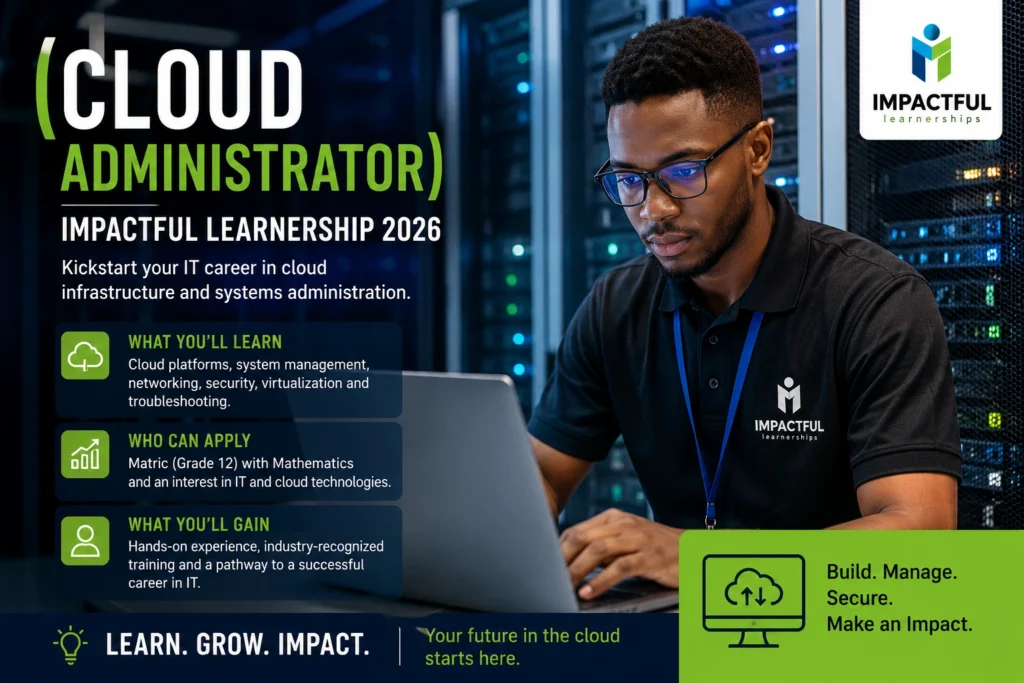
The (Cloud Administrator) Impactful Learnership 2026 offers a potential solution by providing training that leads to the Occupational Certificate: Cloud Administrator (SAQA ID 118699) at National Qualifications Framework (NQF) Level 4. Unlike many traditional academic programmes, this qualification combines classroom knowledge, practical technical training, and workplace experience to prepare learners for real cloud administration responsibilities.
However, prospective applicants should also understand an important detail: Impactful has not confirmed an active funded 2026 intake, sponsoring employer, stipend, programme duration, or application closing date. Anyone interested should verify these details directly before making travel arrangements or submitting personal documents.
This guide explains everything you need to know about the programme, who it is suitable for, what skills you’ll learn, and how to prepare if applications become available.
What Is the (Cloud Administrator) Impactful Learnership 2026?
The (Cloud Administrator) Impactful Learnership 2026 is built around a nationally recognised occupational qualification designed to prepare learners for careers in cloud computing and IT infrastructure.
Instead of focusing only on theory, the programme combines:
- Technical knowledge
- Practical cloud administration
- Workplace learning
- Industry-standard assessment
The qualification carries 149 credits, divided into:
- 38 Knowledge Credits
- 55 Practical Skills Credits
- 56 Workplace Experience Credits
This balance ensures learners understand both the concepts behind cloud computing and the practical tasks required in modern IT environments.
Successful candidates receive the:
Occupational Certificate: Cloud Administrator (SAQA ID 118699)
This qualification can support entry-level careers including:
- Cloud Administrator
- Cloud Support Technician
- Junior Cloud Engineer
- Infrastructure Support Technician
- Cloud Operations Assistant
- Systems Support Technician
Why This Issue Matters
Cloud computing has become the backbone of modern business.
Companies now rely on cloud platforms to store information, run applications, secure customer data, and support employees working from different locations. Organisations across banking, healthcare, retail, telecommunications, government, and education continue moving their systems into cloud environments.
As more businesses adopt services such as Microsoft Azure, Amazon Web Services (AWS), and Google Cloud Platform, the demand for skilled cloud professionals continues to grow.
For South African learners, qualifications that combine practical workplace training with recognised certification can improve employability compared to relying only on self-study.
At the same time, many fake learnership advertisements appear online. Understanding exactly what has—and has not—been confirmed helps applicants avoid scams and make informed decisions.
Who Can Apply?
According to the available qualification information, applicants should generally have:
- Grade 12 (Matric)
- Basic computer knowledge
- NQF Level 3 End User Computing (listed as an entry requirement)
- Interest in technology
- Willingness to complete practical learning
Because no funded intake has been announced, applicants should verify whether every listed requirement applies once recruitment officially opens.
This qualification may be particularly suitable for:
- School leavers interested in IT
- Entry-level technical support staff
- Career changers moving into technology
- Individuals with basic computer skills seeking structured training
- People interested in networking and cloud infrastructure
(Cloud Administrator) Impactful Learnership 2026: Skills You’ll Learn
One of the strongest features of this qualification is its practical focus.
Rather than simply learning definitions, participants develop technical abilities used in cloud administration roles.
Topics include:
Cloud Computing Fundamentals
Learners understand:
- Public cloud
- Private cloud
- Hybrid cloud
- Cloud service models
- Cloud deployment strategies
This creates a solid foundation before moving into advanced administration tasks.
Server Administration
Participants learn how to:
- Configure servers
- Monitor server performance
- Allocate computing resources
- Maintain system stability
These skills are valuable across many IT support environments.
Networking
Networking remains one of the most important areas in cloud computing.
Training includes:
- Network configuration
- Connectivity
- Performance monitoring
- Troubleshooting
- Infrastructure management
Data Storage and Databases
Modern businesses generate enormous amounts of data.
Learners explore:
- Cloud storage
- Database concepts
- Data management
- Storage optimisation
- Backup procedures
Containers and Kubernetes
Container technology is becoming increasingly important in cloud environments.
The programme introduces learners to:
- Containers
- Cloud-native applications
- Kubernetes basics
- Application deployment
These are valuable skills for organisations modernising their IT infrastructure.
Cloud Security
Security forms a major component of the qualification.
Learners study:
- Threat prevention
- Risk management
- Security controls
- Access management
- Cloud governance
Protecting business systems is one of the primary responsibilities of cloud administrators.
Structured Query Language (SQL)
Participants also develop introductory database skills including:
- SQL basics
- Data retrieval
- Spreadsheet analysis
- Data visualisation
These skills support reporting and business decision-making.
Design Thinking
Technology professionals often solve business problems rather than simply fixing computers.
The programme introduces:
- Problem-solving
- Innovation
- Collaboration
- User-focused thinking
How Learners Earn the Qualification
Completing the programme involves more than attending classes.
Learners must successfully complete:
Knowledge Assessments
These evaluate understanding of cloud computing concepts.
Practical Assessments
Learners demonstrate technical abilities through hands-on activities.
Workplace Experience
Practical workplace exposure allows learners to apply skills in realistic environments.
External Integrated Summative Assessment
The final assessment is conducted at an accredited assessment centre under Quality Council for Trades and Occupations (QCTO) requirements.
Passing this assessment is essential for receiving the occupational certificate.
Where Can Training Take Place?
Impactful currently lists three possible delivery options:
- Classroom learning in Johannesburg
- Virtual instructor-led learning
- On-site training arranged nationally
However, no confirmed training schedule has yet been published for a funded 2026 intake.
Before accepting any offer, applicants should ask:
- Where training will take place
- Whether travel is required
- Attendance expectations
- Workplace placement arrangements
- Start dates
Step-by-Step Guide to Preparing for the Programme
If recruitment opens, preparation can significantly improve your chances.
Step 1: Organise Your Documents
Prepare certified copies of:
- South African ID
- Grade 12 certificate
- Academic records
- Updated CV
- Proof of residence (if requested)
APPLY HERE: Impactful Learnership 2026
Having documents ready saves time once applications open.
Step 2: Improve Your Computer Skills
Even basic experience with:
- Windows
- Microsoft Office
- File management
- Internet usage
will make technical training easier.
Free online learning platforms also offer introductory cloud computing courses that can strengthen your understanding.
Step 3: Learn Basic Networking
Understanding concepts such as:
- IP addresses
- Routers
- Servers
- Wi-Fi
- Networks
provides an advantage before training begins.
Step 4: Stay Updated
Because no application deadline has been published, regularly monitor official announcements for:
- Sponsored learner intakes
- Registration dates
- Closing dates
- Required documents
Avoid relying on unofficial social media posts.
Step 5: Verify Every Opportunity
Before sharing personal information, confirm:
- Sponsoring employer
- Monthly stipend
- Programme duration
- Training venue
- Recruitment process
Never assume every course automatically includes paid workplace learning.
ALSO APPLY FOR: Clover Learnership 2026
Best Practices Experts Recommend
Career advisors and IT professionals often suggest the following strategies for aspiring cloud administrators:
- Build strong digital literacy before applying.
- Practise troubleshooting everyday computer problems.
- Learn basic networking concepts independently.
- Develop communication skills alongside technical abilities.
- Keep copies of all application documents ready.
- Follow only official recruitment announcements.
- Ask questions whenever programme information is unclear.
- Continue learning beyond the qualification through reputable online resources and industry certifications.
Technology changes rapidly, so continuous learning is one of the biggest advantages in cloud careers.
Mistakes People Often Make
Many applicants reduce their chances by making avoidable errors.
Common mistakes include:
Applying without reading requirements
Always confirm eligibility before submitting an application.
Assuming every learnership pays a stipend
Currently, no stipend has been confirmed for this programme.
Ignoring official communication
Applicants sometimes rely on WhatsApp messages instead of official updates.
Submitting incomplete documents
Missing academic records or uncertified copies can delay processing.
Waiting until the last minute
If applications open unexpectedly, being prepared gives you an advantage.
Believing every online advertisement
Always verify information directly with the training provider.
Competition Level
Competition: Medium to High
Cloud computing remains one of South Africa’s fastest-growing technology sectors.
Although the qualification provides an accessible Grade 12 pathway, funded opportunities are likely to attract significant interest if announced.
Candidates who demonstrate genuine interest in technology, prepare documentation early, and strengthen their computer knowledge may improve their competitiveness.
Safety and Scam Check
Before applying:
✔ Confirm that recruitment has officially opened.
✔ Verify whether a sponsoring employer exists.
✔ Confirm whether the programme includes a stipend.
✔ Never pay an application fee for a legitimate learnership.
✔ Do not send certified documents to unofficial email addresses or social media accounts.
✔ Request written confirmation of programme details where possible.
Treat the current course information as an opportunity to express interest rather than proof of an active funded intake.
Frequently Asked Questions
Does the (Cloud Administrator) Impactful Learnership 2026 guarantee employment?
No. Completing the qualification improves your skills and employability, but employment depends on available opportunities and employer requirements.
Has a monthly stipend been confirmed?
No. The available information does not confirm a stipend, sponsoring employer, or payment schedule for a 2026 intake.
Can Grade 12 learners apply?
Grade 12 is listed as an entry requirement, together with basic computer knowledge and NQF Level 3 End User Computing. Applicants should confirm the final requirements once recruitment opens.
Where will training take place?
Possible options include Johannesburg classroom training, virtual instructor-led learning, or on-site delivery nationwide. The final training arrangement depends on the specific intake.
Final Thoughts
The (Cloud Administrator) Impactful Learnership 2026 represents an encouraging pathway for South Africans interested in cloud computing and IT support. By combining theoretical learning, practical technical training, workplace experience, and an industry-recognised Occupational Certificate, the programme can help learners build valuable skills for entry-level cloud careers.
However, it is equally important to approach the opportunity carefully. At the time of writing, no funded learner intake, sponsoring employer, programme duration, stipend, or application closing date has been officially confirmed. Prospective applicants should treat the available information as an overview of the qualification rather than confirmation that recruitment is currently underway.
The most practical approach is to prepare your documents, strengthen your basic computer and networking knowledge, monitor official announcements, and verify all programme details before applying. Being informed and prepared will place you in a stronger position if a funded intake becomes available.