

Finding your first job can feel almost impossible when every vacancy asks for experience you do not yet have. Thousands of unemployed young South Africans leave school every year with Grade 10 or Matric, only to discover that employers want practical workplace skills alongside academic qualifications. This creates a frustrating cycle where young people cannot gain experience because nobody gives them an opportunity.
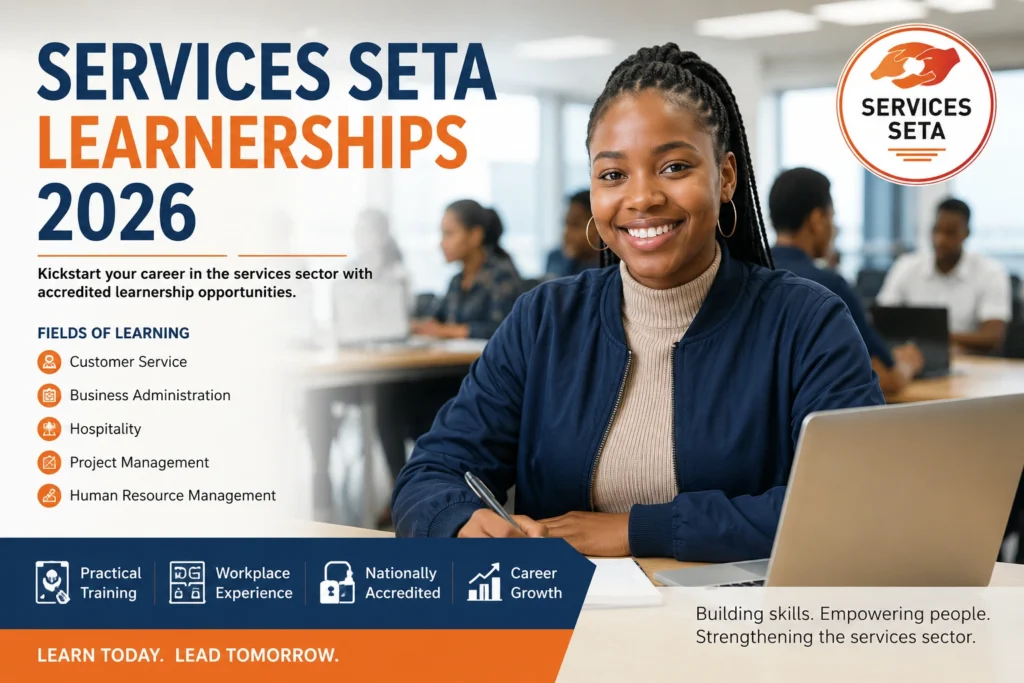
That is exactly why Services SETA Learnerships 2026 are attracting so much attention. Instead of expecting applicants to already have years of experience, these learnerships combine structured training with real workplace exposure. Participants receive practical skills, work alongside experienced professionals and usually earn a monthly stipend while completing a nationally recognised qualification.
If you are between 18 and 34 years old and looking for a way to build your career without needing a university degree, this guide explains everything you need to know—from eligibility requirements to application tips that can improve your chances of being selected.
What Are Services SETA Learnerships 2026?
The Services SETA Learnerships 2026 programme is an initiative of the Services Sector Education and Training Authority (Services SETA), one of South Africa’s Sector Education and Training Authorities responsible for developing workplace skills in the services industry.
Unlike traditional classroom education, a learnership combines two important components:
- Structured theoretical training through an accredited training provider.
- Practical workplace experience with an employer.
This means learners don’t only study—they also apply what they learn in real workplaces.
Depending on the programme, successful participants work toward a qualification registered on the National Qualifications Framework (NQF), making the qualification nationally recognised across South Africa.
Why This Issue Matters
South Africa continues to face high youth unemployment, particularly among school leavers who have limited work experience.
Many employers report that entry-level applicants often lack workplace readiness rather than academic ability. Learnerships help bridge this gap by allowing participants to develop:
- Practical job skills
- Communication abilities
- Workplace discipline
- Teamwork experience
- Professional confidence
For many young people, a learnership becomes their first formal employment experience, making future job applications much stronger.
It also helps employers identify talented young workers who may later be offered permanent employment if vacancies become available.
Who Can Apply?
One reason Services SETA Learnerships 2026 are popular is because many programmes do not require tertiary qualifications.
General requirements usually include:
- South African citizenship
- Valid South African ID
- Age between 18 and 34 years
- Grade 10 or Grade 12 (depending on the specific programme)
- Currently unemployed
- Not studying full-time
- Available for the full learnership period
People living with disabilities are also encouraged to register, with many programmes promoting inclusive participation.
Keep in mind that accredited training providers or employers may introduce additional requirements depending on the specific qualification.
Which Provinces Are Included?
The programme is available nationwide.
Applicants from all nine provinces can register, including:
- Eastern Cape
- Free State
- Gauteng
- KwaZulu-Natal
- Limpopo
- Mpumalanga
- North West
- Northern Cape
- Western Cape
Availability may differ because placements depend on participating employers and accredited training providers operating within each province.
Living in a rural area does not automatically prevent someone from qualifying, although opportunities may vary from one district to another.
What Fields Are Available?
The services sector is one of South Africa’s largest employment sectors.
Possible learnership fields include:
- Business Administration
- Project Management
- Marketing
- Customer Service
- Contact Centre Operations
- Cleaning Services
- Office Administration
- Retail Support Services
- Hospitality Support
- Professional Services
The exact fields available during each intake depend on employer demand and accredited training providers.
When registering, it is important to complete your learner profile carefully because this information helps match you with suitable opportunities.
What Benefits Can Learners Receive?
One of the biggest advantages of participating in Services SETA Learnerships 2026 is that learners gain more than just a certificate.
Potential benefits include:
- Nationally recognised qualification
- Practical workplace experience
- Monthly stipend
- Industry-relevant skills
- Improved communication abilities
- Professional mentoring
- Workplace references
- Better employability
Although many people focus on the stipend, the workplace experience is often the most valuable long-term benefit because employers frequently prioritise applicants who have worked in structured environments before.
Step-by-Step Guide to Registering Successfully
Applying correctly significantly improves your chances of being considered.
Step 1: Gather Your Documents
Prepare certified copies of:
- South African ID
- Grade 10 or Matric certificate
- Updated CV
- Proof of residence
- Any additional qualifications
- Any supporting documents requested
Make sure documents are clear and readable before uploading.
Step 2: Update Your CV
Even if you have never worked before, include:
- School subjects
- Computer literacy
- Volunteer work
- Community projects
- Leadership positions
- Sports achievements
- Short courses
- Languages spoken
Many first-time applicants underestimate how valuable these experiences are.
Step 3: Register on the Learner Portal
Create your learner profile carefully.
Double-check:
- Phone number
- Email address
- Residential details
- Educational history
APPLY HERE: Services SETA Learnerships 2026
Incorrect contact details are one of the easiest ways to miss future opportunities.
Step 4: Complete Your Profile Properly
Avoid rushing through the registration.
Complete every section honestly.
Incomplete learner profiles are less useful when providers search for suitable candidates.
Step 5: Upload Supporting Documents
Before submitting:
- Ensure scans are readable.
- Save documents in accepted formats.
- Use clear file names.
- Confirm uploads completed successfully.
Step 6: Monitor Your Email and Phone
Registration does not automatically guarantee placement.
Training providers may contact shortlisted applicants weeks or months later.
Missing calls or ignoring emails could result in losing an opportunity.
ALSO APPLY FOR: AVBOB Learnerships 2026
Documents You Should Prepare
Having documents ready before registration saves time.
Prepare:
- Certified ID copy
- Certified Grade 10 or Matric results
- Updated CV
- Proof of residence
- Additional qualifications
- Disability documentation (where applicable)
Some providers may also request SARS or banking details after successful placement.
How Selection Usually Works
Many applicants believe registration guarantees acceptance.
It does not.
Generally, the process works like this:
- Register on the learner database.
- Accredited providers search for suitable candidates.
- Shortlisted applicants may be contacted.
- Documents are verified.
- Interviews or assessments may take place.
- Successful candidates are placed with employers.
Selection depends on available funded opportunities rather than simply registering first.
Best Practices Experts Recommend
Career advisors consistently recommend several habits that improve applicants’ chances.
Apply Early
The July 2026 intake closes once available places are filled.
Waiting until the last minute may mean missing available opportunities.
Keep Contact Details Updated
Always ensure your cellphone number and email remain active.
Many opportunities are lost simply because applicants cannot be reached.
Build Basic Computer Skills
Even simple Microsoft Word, Excel and email skills make candidates more attractive for administrative learnerships.
Free online digital literacy courses can strengthen your profile.
Stay Organised
Create a folder containing:
- CV
- Certified documents
- Certificates
- Application records
This makes applying for future opportunities much easier.
Continue Applying Elsewhere
Do not rely on one application.
Continue applying for:
- Other SETA learnerships
- Apprenticeships
- Internships
- Entry-level jobs
A broader job search increases your chances of success.
Mistakes People Often Make
Many unsuccessful applications could have been avoided.
Common mistakes include:
Submitting an Outdated CV
A CV from several years ago may omit valuable recent achievements.
Always update it before applying.
Using an Inactive Phone Number
If recruiters cannot reach you, they usually move to the next applicant.
Uploading Poor-Quality Documents
Dark photographs or blurry scans can delay verification.
Use clear certified copies.
Registering but Never Checking Email
Some applicants assume they will only receive phone calls.
Many providers communicate by email.
Applying Without Reading Requirements
Some learnerships require Grade 12 while others accept Grade 10.
Always read the eligibility criteria carefully before applying.
How This Learnership Can Improve Your Career
A Services SETA learnership is not only about temporary income.
Participants often develop transferable skills including:
- Customer service
- Professional communication
- Time management
- Problem solving
- Administrative skills
- Team collaboration
These skills are valued across multiple industries.
Even if permanent employment is not offered immediately after completing the programme, graduates usually have stronger CVs than applicants with no workplace experience.
Frequently Asked Questions
Do I need Matric to apply?
Not always.
Some Services SETA Learnerships 2026 accept applicants with Grade 10, while others require Grade 12 depending on the qualification.
Is there a monthly stipend?
Many learnerships provide a monthly stipend, although the amount varies according to the funded programme and training provider.
Can people living with disabilities apply?
Yes.
People living with disabilities are encouraged to register and may qualify for dedicated opportunities offered by participating employers.
Does registering guarantee placement?
No.
Registration places your information on the learner database, but selection depends on available funded learnership opportunities and employer requirements.
Final Thoughts
For many unemployed South Africans, Services SETA Learnerships 2026 represent more than a training programme—they offer a practical starting point for building a career. By combining classroom learning with workplace experience, these learnerships help participants develop valuable skills while working toward a recognised qualification and, in many cases, receiving a monthly stipend.
If you meet the eligibility requirements, avoid delaying your registration. Prepare your documents carefully, update your CV, complete your learner profile accurately and keep your contact information current. Remember that registration alone does not guarantee placement, so continue applying for other learnerships and entry-level opportunities while waiting for feedback.
A well-prepared application can open doors not only to this programme but also to future employment opportunities. The experience, confidence and professional skills gained through a learnership often become the foundation for long-term career growth.