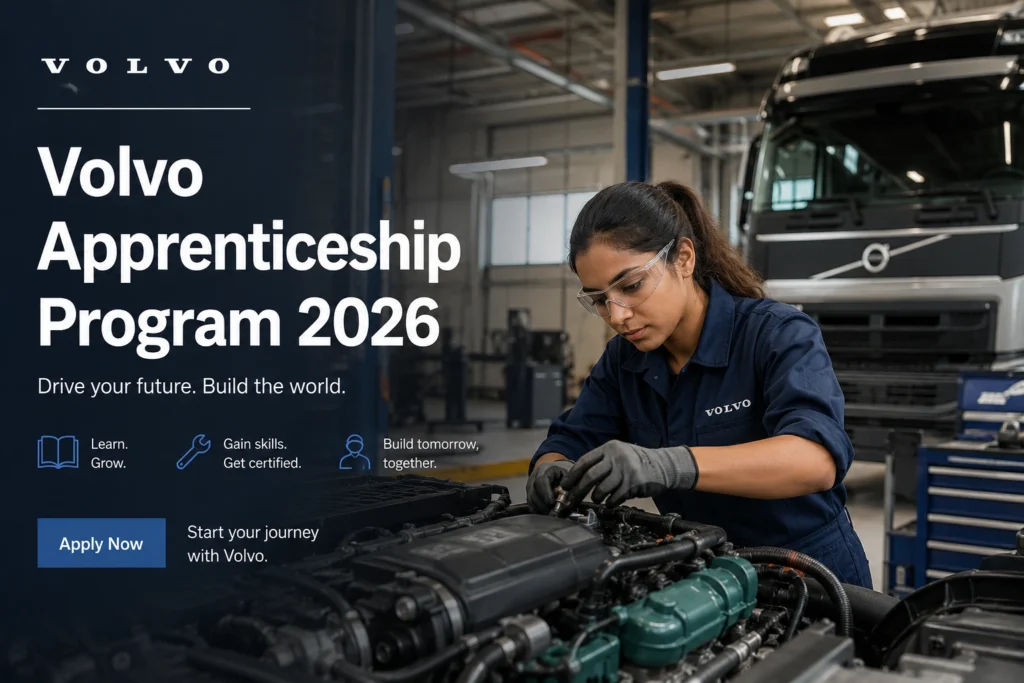

The Volvo Apprenticeship Program is attracting renewed interest in 2026 for a reason that goes beyond trucks, engines, or factory floors. Across the automotive and transport industries, employers are facing a growing shortage of technically skilled workers at the exact moment vehicles are becoming more digital, electric, and software-driven.
That tension is pushing apprenticeship programs back into the spotlight.
For many young people, especially those trying to avoid heavy student debt or struggling to enter competitive job markets, vocational training suddenly looks less like a backup plan and more like a strategic career move. At the same time, global manufacturers such as Volvo Group are increasingly investing in technician pipelines because they cannot afford future skills gaps.
The result is that the Volvo Apprenticeship Program is no longer viewed as a niche industrial pathway. It is becoming part of a wider conversation about employment, economic resilience, and how modern careers are changing.
And after the February 2026 Google Discover update — which now appears to reward timely, insight-driven commentary with strong user engagement signals — stories around practical career pathways, apprenticeships, and future-proof jobs have gained noticeable traction online.
The Bigger Shift Behind the Volvo Apprenticeship Program
For years, apprenticeships were often discussed in traditional terms: manual work, workshop training, and trade certification.
That perception has changed dramatically.
Modern automotive apprenticeships now involve diagnostics software, battery systems, EV servicing, logistics technology, robotics, and data-assisted maintenance. A technician entering the industry today may spend as much time using digital diagnostic systems as mechanical tools.
The Volvo Apprenticeship Program reflects that shift.
Instead of simply preparing workers for routine repair work, programs connected to the Volvo ecosystem increasingly focus on long-term technical adaptability. Apprentices learn how modern transport systems operate in real-world environments where automation, sustainability goals, and connected vehicle technology are becoming standard.
That matters because the transport sector itself is evolving quickly.
Commercial fleets are under pressure to reduce emissions. Logistics companies are modernizing operations. Public transport systems are adopting smarter technologies. And electric heavy vehicles are no longer theoretical products for the distant future.
Manufacturers know they need technicians capable of handling this transition.
The apprenticeship model has therefore become a recruitment strategy as much as a training initiative.
Why Apprenticeships Are Trending Again in 2026
The renewed attention around programs like the Volvo Apprenticeship Program is tied to several overlapping trends happening globally.
First, university costs continue to rise in many countries, while graduate employment outcomes remain inconsistent. That has led more students and parents to reassess whether traditional academic routes guarantee stable careers.
Second, industries facing aging workforces are struggling to replace experienced technical staff. In sectors such as transport engineering and vehicle maintenance, retirements are accelerating faster than recruitment.
Third, younger workers are increasingly prioritizing practical experience alongside earning potential. Apprenticeships offer something many entry-level jobs do not: structured learning with real workplace exposure.
This combination has changed the conversation.
Apprenticeships are now being discussed alongside cybersecurity bootcamps, tech certifications, and digital skills academies as alternative career pathways that can lead directly into employment.
For companies like Volvo, this creates both an opportunity and a necessity.
How the Situation Developed
The roots of today’s apprenticeship revival stretch back several years.
During the pandemic era, many industries reduced training investments or paused workforce development programs entirely. That created a delayed effect: fewer trainees entered technical professions at the same time older workers continued leaving.
Now the gap is visible.
Automotive companies across Europe, Africa, North America, and parts of Asia are competing for skilled technicians, especially those comfortable working with electric vehicle systems and advanced diagnostics.
The Volvo Apprenticeship Program emerged within this broader labor-market pressure.
Historically, Volvo’s training initiatives focused heavily on dealership support, engineering development, and technical maintenance. But over time, the scope expanded to include sustainability-related competencies, digital systems, and advanced service technologies.
The transformation of heavy transport accelerated the need for change.
Electric trucks require different servicing expertise than diesel fleets. Connected vehicle systems require technicians who can interpret software-generated performance data. Fleet maintenance increasingly depends on predictive systems rather than reactive repairs.
Apprenticeships had to evolve accordingly.
Recent Developments Around Technical Training
One reason apprenticeship programs are receiving stronger media and social attention in 2026 is that governments and private companies are actively repositioning vocational education as economically strategic.
In many regions, policymakers now openly discuss skills shortages as national economic risks.
Manufacturers, meanwhile, are forming stronger partnerships with colleges, technical institutes, and training centers. The goal is clear: reduce the time between education and employability.
The Volvo Apprenticeship Program fits neatly into that conversation because it represents a recognizable global brand adapting to workforce realities.
There is also increasing interest in how apprenticeships intersect with sustainability goals.
Electric mobility ambitions sound impressive in corporate presentations, but they require a workforce capable of maintaining and operating those systems in practice. Without trained technicians, infrastructure upgrades alone are not enough.
That has made technical education more politically and commercially important than it was even five years ago.
Public Reaction Has Been Surprisingly Strong
Online discussions about apprenticeships in 2026 reveal a notable shift in public sentiment.
Previously, vocational pathways were sometimes framed as second-tier options compared to university degrees. That stigma has weakened considerably, especially among younger audiences exposed to unstable graduate employment markets.
Social media discussions now frequently highlight:
- Real-world earning potential
- Lower educational debt
- Faster workforce entry
- Practical experience advantages
- Career stability in technical sectors
The Volvo Apprenticeship Program often appears within these conversations because recognizable employers provide a sense of credibility and structure.
At the same time, skepticism still exists.
Some critics argue that apprenticeship systems can vary widely in quality depending on location, mentorship, and industry standards. Others worry about whether training programs can keep pace with rapid technological change.
Those concerns are valid.
An apprenticeship tied to outdated systems may not prepare workers for future industry demands. The quality of mentorship, certification, and technological exposure matters enormously.
Still, the broader public mood appears increasingly supportive of skilled-trade career pathways.
Why This Matters Right Now
The timing matters because the global labor market is entering a complicated transition period.
Artificial intelligence is reshaping office work. Automation is changing manufacturing. Companies are reducing some entry-level white-collar hiring while simultaneously struggling to fill technical positions.
That contradiction is reshaping career planning.
The Volvo Apprenticeship Program represents a model that blends human expertise with evolving technology rather than competing against it.
Technicians working on advanced transport systems are not simply performing repetitive labor. They are interacting with digital platforms, diagnostics software, battery technologies, and increasingly intelligent machines.
In other words, these roles are becoming more technologically sophisticated rather than less relevant.
This matters especially for younger workers trying to identify careers less vulnerable to rapid disruption.
Practical technical work linked to infrastructure, mobility, logistics, and transport maintenance remains difficult to automate fully because it requires physical problem-solving, adaptability, and real-world decision-making.
That gives apprenticeship pathways new economic relevance.
APPLY HERE: Volvo Apprenticeship Program 2026
ALSO APPLY FOR: Premier Millwright Apprenticeship 2026
The EV Transition Is Changing Everything
One of the biggest reasons the Volvo Apprenticeship Program matters in 2026 is the electric vehicle transition.
Electric commercial vehicles require entirely different servicing ecosystems compared to traditional fleets. Battery diagnostics, charging infrastructure, thermal management systems, and software integration are all becoming core competencies.
This creates a training challenge.
Companies cannot simply retrain entire industries overnight. They need ongoing talent pipelines capable of supporting the transition over many years.
Apprenticeships help solve part of that problem.
By training workers early within evolving systems, manufacturers can gradually build future-ready technical workforces instead of reacting to shortages after they become critical.
That strategy is increasingly visible across the automotive sector.
There’s Also a Broader Economic Story Here
The popularity of apprenticeship-related content is not only about careers.
It also reflects anxiety about economic mobility.
In many countries, younger workers feel traditional employment ladders have become harder to climb. Housing costs are high. Entry-level salaries often lag behind living expenses. And academic qualifications alone no longer guarantee secure employment.
Programs like the Volvo Apprenticeship Program attract attention because they appear to offer a clearer connection between training and employability.
That perceived practicality resonates strongly online.
Readers are increasingly drawn to stories that feel immediately useful rather than purely aspirational. Google Discover’s recent emphasis on engagement quality and topical relevance appears to align with this shift.
People want information connected to real economic decisions.
The Corporate Reputation Angle
For major brands, apprenticeship programs also carry reputational value.
Consumers increasingly evaluate companies not only by products but by workforce investment, sustainability commitments, and long-term economic contribution.
A visible apprenticeship initiative signals several things simultaneously:
- Investment in future talent
- Commitment to workforce development
- Adaptation to industry change
- Support for practical education
- Long-term operational planning
That messaging matters in a competitive global market where companies are trying to position themselves as forward-looking employers.
The Volvo Apprenticeship Program therefore functions as both a training initiative and a broader brand statement.
What Could Happen Next
Several possible developments could shape the future of apprenticeship programs over the next few years.
The first is expansion into hybrid technical roles.
Future apprentices may increasingly combine mechanical training with software literacy, data analysis, and sustainability-focused skills. The distinction between technician and technology specialist could continue narrowing.
Second, partnerships between manufacturers and educational institutions are likely to deepen.
Companies may become more directly involved in curriculum design to ensure graduates match real industry needs rather than outdated academic frameworks.
Third, apprenticeship recruitment could become more globally competitive.
As technical skills shortages intensify, multinational companies may actively compete for young talent earlier through internships, scholarships, and pre-apprenticeship programs.
There is also the possibility of stronger government involvement.
Countries concerned about youth unemployment and industrial competitiveness may expand incentives for vocational training initiatives connected to sectors such as logistics, renewable energy, and advanced manufacturing.
However, challenges remain.
Training quality must keep pace with technology. Apprentices need clear progression opportunities rather than temporary labor arrangements. And industries must ensure vocational pathways remain adaptable as technology evolves.
The success of programs like the Volvo Apprenticeship Program will ultimately depend on whether they provide long-term career resilience rather than short-term workforce solutions.
The Conversation Around Skilled Work Has Changed
Perhaps the most interesting part of the current discussion is cultural rather than industrial.
For years, digital-era career conversations focused heavily on coding, startups, and remote work. But 2026 is revealing a broader realization: modern economies still depend heavily on physical infrastructure, logistics systems, manufacturing expertise, and skilled technical labor.
Someone still has to maintain transport networks.
Someone still has to service advanced vehicles.
Someone still has to bridge the gap between software-driven systems and real-world operations.
That reality is giving apprenticeship programs renewed visibility and relevance.
The Volvo Apprenticeship Program sits at the center of that conversation because it represents more than one company’s hiring strategy. It reflects how industries are trying to prepare for technological transformation while solving practical workforce problems at the same time.
And that is why interest in apprenticeship pathways suddenly feels much bigger than vocational training alone.