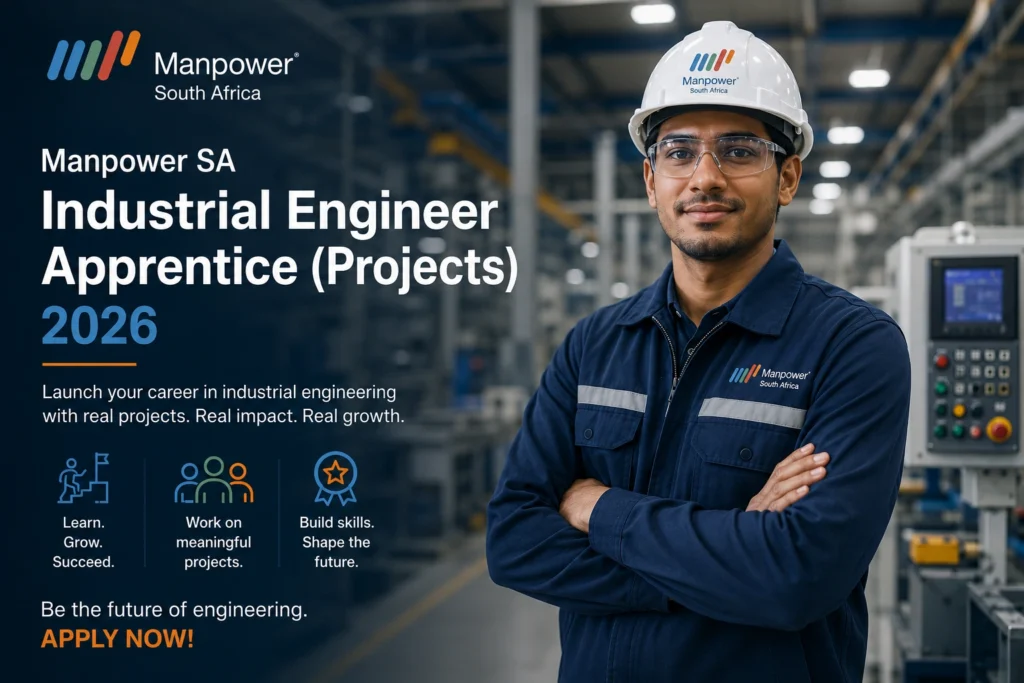

The manufacturing industry is changing rapidly, and companies are searching for professionals who can improve efficiency, reduce waste, and lead innovation. That is exactly why the Manpower SA Industrial Engineer Apprentice opportunity has attracted so much attention in South Africa’s engineering sector.
For experienced industrial engineers looking to move beyond routine operational work, this role offers something bigger: the chance to lead impactful projects inside a fast-moving FMCG and food production environment. From process optimisation to project implementation, this opportunity is designed for engineers who want to influence how modern manufacturing works.
Whether you are already working in production, recently completed a degree in industrial engineering, or are planning your next career move, understanding what this role involves can help you decide whether it matches your long-term goals.
What You Should Know First
The Manpower SA Industrial Engineer Apprentice role is a permanent engineering opportunity based in Cape Town’s Northern Suburbs. It focuses on operational improvement, project management, Lean manufacturing, and continuous improvement within the FMCG sector.
Here are the key points:
- Position: Industrial Engineer (Projects)
- Industry: FMCG/Food Production
- Experience Needed: Around 5 years
- Qualification: BEng, BSc, or BTech in Industrial Engineering
- Salary: R66,700–R70,000 per month
- Contract Type: Permanent
- Main Focus: Process optimisation and project implementation
This is not a beginner-level apprenticeship in the traditional sense. Instead, it is a high-responsibility engineering role aimed at professionals with practical manufacturing experience.
APPLY HERE: Manpower SA Industrial Engineer Apprentice
Why Industrial Engineers Matter in Modern Manufacturing
Industrial engineers play a major role in helping companies produce goods faster, cheaper, and with fewer errors. In manufacturing industries like food production, even small process improvements can save millions of rand over time.
An industrial engineer typically focuses on:
- Improving workflow systems
- Reducing production downtime
- Increasing productivity
- Eliminating waste
- Improving factory layouts
- Managing operational projects
- Supporting quality improvement initiatives
In FMCG environments, speed and consistency are extremely important. Products must move efficiently through production lines while maintaining safety and quality standards. This is where industrial engineers become essential.
The Manpower SA Industrial Engineer Apprentice role places candidates directly in this high-impact environment.
Understanding the Role Step-by-Step
1. Project Leadership Responsibilities
One of the biggest parts of this opportunity involves leading projects from beginning to end.
This means you may be responsible for:
- Identifying operational problems
- Planning improvement strategies
- Managing project timelines
- Coordinating different departments
- Tracking budgets
- Measuring project outcomes
For example, imagine a factory producing packaged food products experiences delays during packaging. An industrial engineer might:
- Analyse production data
- Identify bottlenecks
- Redesign workflow systems
- Introduce automation improvements
- Monitor performance after implementation
The goal is not just fixing problems temporarily but creating long-term operational improvements.
2. Continuous Improvement and Lean Manufacturing
Many manufacturing companies now rely heavily on Lean and Six Sigma methodologies.
These systems help businesses:
- Reduce waste
- Improve consistency
- Lower operating costs
- Improve production speed
- Increase customer satisfaction
In this role, candidates are expected to drive continuous improvement initiatives.
A simple example of Lean thinking might include:
- Reducing unnecessary movement on production floors
- Improving machine setup times
- Standardising processes using SOPs
- Minimising material waste
Companies value engineers who can identify inefficiencies others overlook.
The Skills Employers Want Most
The Manpower SA Industrial Engineer Apprentice role combines technical knowledge with strong interpersonal skills.
Technical Skills
Candidates should understand:
- Production systems
- Workflow optimisation
- Manufacturing operations
- Data analysis
- Process mapping
- Project management
- Continuous improvement frameworks
Knowledge of tools like:
- Microsoft Excel
- Power BI
- ERP systems
- Lean tools
- Six Sigma principles
can give applicants a competitive advantage.
Soft Skills That Matter
Many engineers underestimate the importance of communication skills.
However, industrial engineers regularly work with:
- Production supervisors
- Plant managers
- Quality assurance teams
- Supply chain professionals
- Technicians
This means candidates must communicate clearly, solve problems quickly, and handle pressure effectively.
Strong stakeholder engagement is especially important because projects often affect multiple departments at once.
Why FMCG Experience Is Valuable
FMCG stands for Fast-Moving Consumer Goods. This industry includes products people buy regularly, such as:
- Food products
- Beverages
- Household goods
- Personal care items
Manufacturing environments in FMCG are extremely demanding because production runs continuously and downtime is expensive.
An engineer working in FMCG learns how to:
- Make fast decisions
- Manage production pressures
- Handle complex operational systems
- Work with strict deadlines
- Improve efficiency without interrupting production
That is why employers often prefer candidates with FMCG or food production experience.
APPLY HERE: Manpower SA Industrial Engineer Apprentice
Salary Expectations and Career Growth
One of the most attractive parts of the Manpower SA Industrial Engineer Apprentice opportunity is the salary package.
The advertised range is:
- R66,700 to R70,000 per month
This places the role among the stronger-paying industrial engineering opportunities in South Africa’s manufacturing sector.
Why Salaries Are Competitive
Industrial engineers directly affect profitability.
If an engineer helps reduce production waste by even 2–3%, companies can save substantial amounts annually.
As a result, experienced engineers with project management abilities are highly valuable.
Long-Term Career Paths
This type of role can lead to future positions such as:
- Operations Manager
- Continuous Improvement Manager
- Manufacturing Excellence Lead
- Plant Manager
- Supply Chain Optimisation Specialist
- Engineering Project Manager
Professionals who combine technical engineering knowledge with leadership experience often advance quickly.
What Makes This Opportunity Different?
Many engineering jobs focus only on maintenance or routine production support.
This opportunity is different because it combines:
- Strategic project work
- Operational improvement
- Cross-functional collaboration
- Leadership responsibilities
- Manufacturing innovation
The role is suited to engineers who want more than repetitive operational duties.
It is especially attractive for professionals who enjoy solving complex systems problems and implementing measurable improvements.
Common Misunderstandings About Manpower SA Industrial Engineer Apprentice
Misunderstanding 1: “It’s Only for Recent Graduates”
Although the title includes the word “Apprentice,” this role is aimed at candidates with approximately five years of experience.
It is more of a project-focused industrial engineering position than a traditional entry-level apprenticeship.
Misunderstanding 2: “Industrial Engineers Only Work on Factory Floors”
Industrial engineers do much more than oversee production lines.
They also:
- Analyse business systems
- Manage projects
- Improve supply chains
- Reduce costs
- Support strategic planning
Their work combines engineering, operations, and business improvement.
Misunderstanding 3: “Lean and Six Sigma Are Optional”
Continuous improvement methodologies are becoming standard across manufacturing industries.
Candidates without exposure to Lean principles or process optimisation tools may struggle to compete in modern manufacturing roles.
Misunderstanding 4: “The Role Is Mostly Administrative”
While reporting and analysis are important, this role is highly practical and operational.
Industrial engineers often spend time:
- Observing production systems
- Working with operational teams
- Solving real-time production challenges
- Testing process improvements
It is a hands-on career path.
How to Prepare for This Opportunity
Step 1: Update Your CV Properly
Focus on measurable achievements rather than listing duties.
Instead of writing:
- “Worked on production projects”
Write:
- “Reduced production downtime by 12% through workflow redesign.”
Employers want evidence of impact.
Step 2: Highlight Project Experience
Even smaller improvement projects matter.
Mention experience involving:
- Cost reduction
- Efficiency improvement
- Process redesign
- Data analysis
- SOP development
- Lean implementation
Step 3: Strengthen Your Data Skills
Modern manufacturing increasingly depends on data-driven decision-making.
Improving skills in:
- Excel
- Power BI
- Reporting dashboards
- KPI tracking
can strengthen your application significantly.
Step 4: Learn Continuous Improvement Frameworks
Candidates with Lean or Six Sigma certifications often stand out.
Even short online certifications can help demonstrate initiative and industry awareness.
APPLY HERE: Manpower SA Industrial Engineer Apprentice
ALSO APPLY FOR: Motus Garsfontein Multifranchise Apprentice 2026
The Importance of Operational Excellence
Operational excellence means creating systems that consistently perform at high levels.
In manufacturing, this affects:
- Profitability
- Product quality
- Customer satisfaction
- Production speed
- Workplace safety
Industrial engineers are central to achieving operational excellence because they connect technical systems with business performance.
This explains why companies continue investing heavily in engineering talent.
Real-World Example of Process Improvement
Imagine a food manufacturing company producing bottled beverages.
Problems arise because:
- Packaging delays slow output
- Workers move excessively between stations
- Downtime increases during shift changes
An industrial engineer could:
- Map current workflows
- Identify wasted movement
- Reorganise workstations
- Improve scheduling systems
- Standardise machine setup procedures
The result might include:
- Faster production
- Lower labour costs
- Reduced downtime
- Higher output consistency
This is the type of improvement work expected in the Manpower SA Industrial Engineer Apprentice role.
Key Takeaways
- The Manpower SA Industrial Engineer Apprentice opportunity focuses on project implementation and operational improvement.
- Candidates typically need around five years of manufacturing or FMCG experience.
- Lean, Six Sigma, and process optimisation knowledge are highly valuable.
- The role combines technical engineering with leadership and communication skills.
- Industrial engineers play a critical role in improving manufacturing efficiency and profitability.
- The salary package is highly competitive within South Africa’s manufacturing sector.
- This opportunity offers strong long-term career growth potential.
Frequently Asked Questions (FAQs)
1. Is the Manpower SA Industrial Engineer Apprentice role suitable for new graduates?
Not usually. The role requires approximately five years of relevant experience, especially in manufacturing or FMCG environments.
2. What industries benefit most from industrial engineers?
Industrial engineers are valuable in industries such as Logistics, Automotive manufacturing, Retail operations, and Warehousing
3. Do I need Lean or Six Sigma certification?
Formal certification is not always mandatory, but practical exposure to Lean or continuous improvement systems is highly beneficial.
4. What makes industrial engineering different from mechanical engineering?
Mechanical engineering focuses more on machines and equipment design, while industrial engineering focuses on improving systems, workflows, productivity, and operational efficiency.
Final Summary
The Manpower SA Industrial Engineer Apprentice opportunity represents far more than a standard engineering vacancy. It is a chance to work at the centre of operational excellence inside a modern manufacturing environment where efficiency, innovation, and continuous improvement drive success.
For engineers who enjoy solving problems, leading projects, and improving systems, this role offers strong earning potential, long-term career growth, and the opportunity to make a measurable impact in one of South Africa’s most important industries.