

Every morning before sunrise, pathology couriers begin moving across South Africa’s cities and towns carrying sealed specimen bags from clinics, hospitals, and doctors’ rooms to laboratories. Inside those bags are blood samples, biopsy tissues, and test requests that may determine whether a patient receives urgent treatment, a chronic diagnosis, or reassuring news.
Most people never think about the chain of people handling those samples before results reach a doctor. Yet behind every test is a system that depends heavily on precision, organisation, and trust.
That is where the Lancet Laboratories Intern 2026 opportunity becomes more important than it may first appear.
For many unemployed South African youth, internships in healthcare are often associated with doctors, nurses, or pharmacists. But the healthcare system also relies on laboratory support teams who keep operations moving accurately and efficiently. Lancet Laboratories’ new Pre-Analytical Internship Programme opens a door into that often overlooked world — one that combines healthcare administration, logistics, technology, and laboratory support.
With unemployment among young South Africans still critically high in 2026, opportunities that provide practical workplace exposure inside established healthcare institutions are attracting growing attention. The Lancet internship is not simply about temporary work experience. It reflects how healthcare support roles are becoming increasingly essential in a country under pressure to improve diagnostic access and patient care.
Inside the Lancet Laboratories Intern 2026 opportunity
The internship programme focuses on the “pre-analytical” phase of laboratory work. In pathology services, this stage happens before scientists and medical technologists begin testing specimens.
That means interns will help ensure samples are correctly received, sorted, logged, scanned, distributed, and tracked through the system. While the work may sound administrative on paper, in practice it sits at the centre of laboratory efficiency.
A mislabeled sample, delayed dispatch, or incomplete registration can affect turnaround times and, in serious cases, patient treatment decisions. Because of this, pathology laboratories place strong emphasis on accuracy and adherence to standard operating procedures.
The Lancet Laboratories Intern 2026 programme gives participants exposure to:
- Sample sorting and registration
- Laboratory administration processes
- Courier coordination and specimen tracking
- Laboratory Information Systems (LIS)
- Healthcare customer service
- Workplace compliance and operational standards
The internship is open to applicants with Grade 12 or an NQF Level 4 qualification, while a BSc degree is considered advantageous rather than compulsory. Importantly, the programme also welcomes individuals with little or no prior work experience, making it accessible to first-time job seekers.
In today’s labour market, that detail matters enormously.
Across South Africa, many young people remain trapped in a cycle where employers demand experience before offering employment. Internship programmes like this attempt to bridge that gap by introducing candidates to professional workplace systems while building practical competencies.
APPLY HERE: Lancet Laboratories Intern 2026
The hidden engine of healthcare laboratories
When South Africans think about healthcare careers, they usually picture hospital wards, ambulances, or consulting rooms. Laboratory support rarely receives the same attention.
Yet pathology services became highly visible during the COVID-19 years, when testing capacity suddenly became a national conversation. Since then, laboratories have continued expanding digital tracking systems, courier networks, and specimen management operations.
The modern pathology environment is no longer just about microscopes and test tubes. It is also about logistics, information management, data accuracy, and workflow coordination.
That broader shift explains why internships focused on pre-analytical support are becoming more structured and specialised.
For young people interested in healthcare but uncertain about clinical careers, the Lancet Laboratories Intern 2026 programme may offer an alternative pathway into the medical sector. Some participants may later pursue careers in laboratory science, healthcare administration, medical technology support, or quality assurance.
Others may simply gain professional experience that strengthens future employability in entirely different industries.
In a difficult economy, transferable workplace skills have become almost as valuable as formal qualifications themselves.
A healthcare internship with real-world pressure
One of the more interesting aspects of the internship description is its honesty about workplace realities.
Applicants are expected to work under pressure, maintain confidentiality, and interact with distressed or nervous patients and healthcare professionals. Those expectations reveal something important about healthcare support work: even non-clinical roles carry emotional and operational responsibility.
In pathology settings, delays and mistakes can have real consequences.
A specimen arriving late from a hospital may impact surgery scheduling. An incorrectly captured patient detail could delay results. During periods of high patient volumes, laboratory support staff often work in fast-moving environments where accuracy cannot be compromised despite pressure.
That makes attention to detail one of the most valuable skills in the programme.
Interestingly, employers across South Africa increasingly prioritise behavioural competencies alongside academic performance. Communication skills, professionalism, adaptability, and ethical conduct now play a bigger role in hiring decisions than many graduates realise.
Lancet’s internship reflects this wider hiring trend.
Why pathology support work is gaining relevance in South Africa
South Africa’s healthcare system continues facing enormous pressure from population growth, disease burdens, and unequal access to medical resources. Diagnostic services are therefore becoming more important across both public and private healthcare sectors.
As healthcare systems digitise further, laboratories require workers who can navigate software systems, maintain accurate records, and support specimen tracking processes efficiently.
The internship specifically mentions the use of Laboratory Information Systems and the Occulus scanning system, highlighting how digital administration has become central to modern pathology operations.
For unemployed youth, exposure to these systems may become a meaningful advantage in future job applications.
Expert-style insight: The rise of healthcare operations careers
One of the less discussed shifts in healthcare employment is the growing importance of operational support roles.
Globally, laboratories and hospitals are investing more heavily in workflow management, digital tracking, compliance systems, and administrative efficiency. South Africa is experiencing the same transition.
This means healthcare careers are expanding beyond traditional clinical professions. Roles linked to data coordination, patient administration, specimen logistics, and laboratory operations are becoming more valuable because healthcare systems increasingly depend on speed, accuracy, and traceability.
Internships like the Lancet Laboratories Intern 2026 programme expose young workers to that evolving side of healthcare early in their careers.
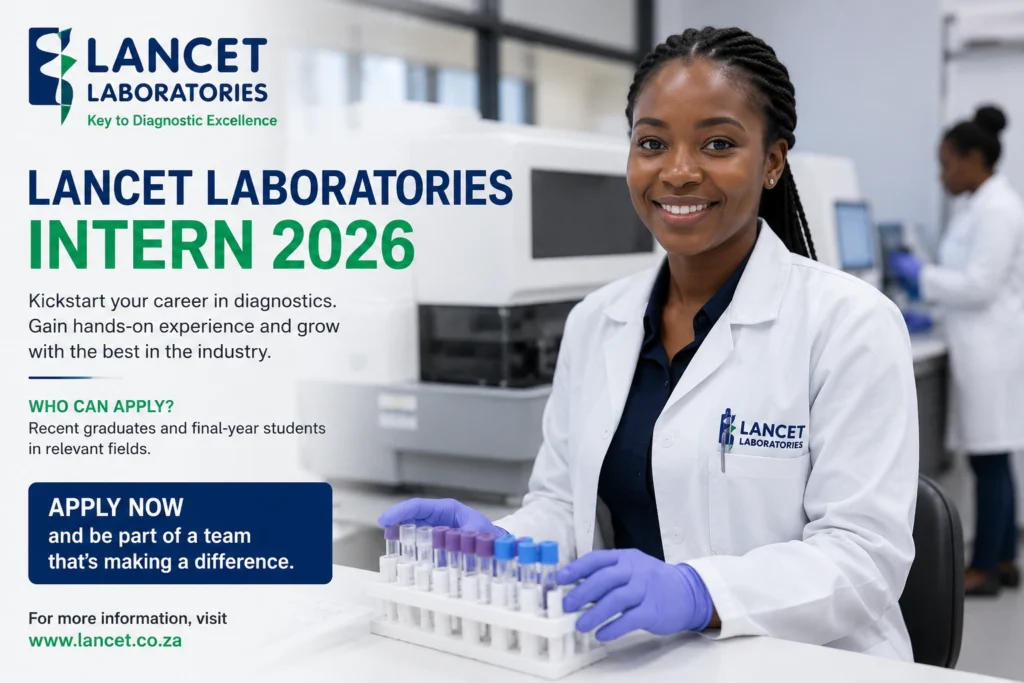
APPLY HERE: Lancet Laboratories Intern 2026
More than just “experience”: what interns may actually learn
Many internship advertisements promise “valuable exposure” without clearly explaining what participants will realistically gain. In this case, the listed responsibilities suggest interns could leave with several practical competencies that are directly useful in professional environments.
These include:
- Working within strict operational procedures
- Managing sensitive healthcare information confidentially
- Understanding laboratory workflow systems
- Using digital administrative tools
- Coordinating time-sensitive processes
- Developing workplace communication skills
Those abilities may sound basic individually, but together they build operational discipline — something employers often struggle to find in entry-level candidates.
In South Africa’s competitive job market, even one year inside a structured professional environment can significantly strengthen a CV.
The healthcare sector also tends to expose workers to high standards of accountability. Employees become accustomed to documentation processes, compliance rules, and performance expectations that are respected across industries.
That is partly why healthcare administration experience can later open doors beyond laboratories themselves.
The emotional reality behind healthcare support roles
There is another side to this internship that deserves more attention.
Working around pathology services means regularly interacting with people experiencing anxiety, illness, or uncertainty. Even if interns are not performing clinical duties, they are still participating in environments connected to serious medical situations.
The internship description specifically mentions dealing with distressed or nervous patients. That requirement signals emotional maturity is just as important as technical ability.
Young applicants sometimes underestimate how emotionally demanding healthcare environments can be. Professionalism in these settings requires patience, empathy, and calm communication.
At the same time, those experiences often help interns develop resilience and interpersonal skills that shape their long-term careers.
Competition for internships is likely to remain intense
The internship closing date is listed as 12 May 2026, with applications processed through Lancet Laboratories’ careers platform.
Given current unemployment levels among South African youth, opportunities linked to recognised healthcare institutions usually attract large numbers of applicants.
Several factors are likely driving that interest:
First, healthcare remains one of the few sectors consistently associated with long-term stability and growth.
Second, many graduates and matriculants are searching for opportunities that provide structured workplace exposure rather than short-term casual jobs.
Third, internships connected to nationally recognised organisations often strengthen future employability even when permanent employment is not guaranteed.
For applicants, that means preparation matters.
A strong application is not only about qualifications. Employers increasingly look for candidates who demonstrate reliability, professionalism, willingness to learn, and genuine interest in the work environment.
Applicants who tailor their CVs carefully and highlight administrative accuracy, communication abilities, or previous volunteer experience may stand out more than they expect.
APPLY HERE: Lancet Laboratories Intern 2026
ALSO APPLY FOR: BCE FoodService Graduate Intern 2026
The broader picture behind youth internships in 2026
South Africa’s internship landscape has changed significantly over the past decade.
In earlier years, many internships were criticised for offering little training or limited career progression. Today, there is growing pressure on employers to create programmes that genuinely develop workplace readiness.
Healthcare-related internships are particularly important because they expose participants to structured operational systems that can strengthen future career mobility.
The Lancet Laboratories Intern 2026 programme fits into a broader trend where companies are investing more in practical skills pipelines instead of relying solely on experienced hires.
This approach benefits employers too. Organisations facing talent shortages increasingly recognise the value of training adaptable entry-level workers internally.
For young South Africans, the challenge is often securing that first opportunity to prove themselves professionally.
That is why internships continue carrying weight far beyond their temporary duration.
FAQ
Who can apply for the Lancet Laboratories Intern 2026 programme?
Applicants need a Grade 12 certificate or relevant NQF Level 4 qualification. A BSc degree is advantageous but not mandatory.
Does the internship require previous work experience?
No. The programme accepts applicants with 0–1 year of relevant experience, making it suitable for first-time job seekers.
What kind of work will interns perform?
Interns will assist with sample sorting, specimen registration, laboratory administration, courier coordination, scanning processes, and maintaining workplace standards within the laboratory environment.
A small opportunity that reflects a bigger shift
At first glance, the Lancet Laboratories Intern 2026 programme may appear like another standard internship advertisement in a crowded job market.
But viewed more closely, it represents something larger happening inside South Africa’s economy and healthcare system.
Healthcare today depends not only on doctors and specialists, but also on efficient operational networks powered by disciplined support staff, digital systems, and coordinated laboratory processes. As these systems expand, the demand for workers who can manage precision-driven administrative tasks is likely to grow alongside them.
For young South Africans searching for direction in an uncertain labour market, internships like this offer more than a line on a CV. They provide exposure to professional systems, real-world accountability, and the rhythms of a critical national industry.
Not every participant will remain in pathology or healthcare permanently. Some may move into administration, logistics, compliance, or technology-related careers later on.
Yet the experience itself — learning how high-pressure professional environments operate — may become the most valuable lesson of all.