

The email arrives just after 9 a.m. It’s not a job offer—yet—but it’s the invitation every recent graduate hopes for: “You have been shortlisted for an interview.” For many young South Africans trying to break into Human Resources, moments like this feel rare. Degrees are completed, CVs are sent out, and weeks pass in silence.
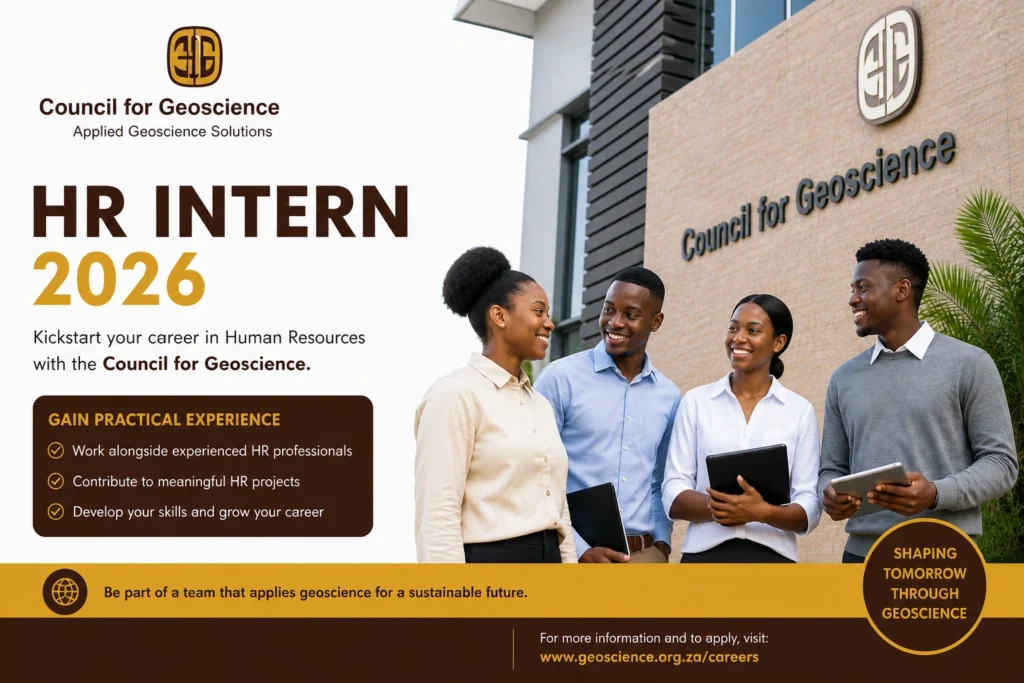
That’s why structured internships like the Council for Geoscience HR Intern 2026 programme matter. They don’t just offer a stipend or a line on a CV—they provide something harder to find: a real entry point into the working world.
Based in Pretoria and running for 24 months, this internship offers three HR graduates the chance to gain practical experience inside a national research institution. With a monthly stipend of R13 000, it’s not just about survival—it’s about learning, contributing, and positioning yourself for long-term career growth.
A foot in the door: why this internship stands out
The Council for Geoscience is not your typical corporate employer. It operates at the intersection of science, government policy, and national development—dealing with geological mapping, mineral resources, and environmental monitoring.
So what does HR look like in a place like this?
It’s structured, compliance-driven, and deeply tied to public sector regulations. For an intern, that means exposure to systems and processes that are often more complex—and more transferable—than what you might find in smaller private companies.
The Council for Geoscience HR Intern 2026 programme is designed for graduates who have the theory but need the practice. There’s no expectation of prior work experience. Instead, the focus is on building competence across core HR functions over two years.
That time frame matters. Many internships last 6–12 months—barely enough to understand workplace dynamics. A 24-month programme allows interns to move beyond observation into real contribution.
APPLY HERE: Council for Geoscience HR Intern 2026
What the role actually involves (beyond the job description)
At first glance, the responsibilities seem familiar: recruitment support, HR administration, employee relations, training coordination. But in practice, each of these areas opens a different window into how organisations function.
Recruitment and onboarding
Interns assist with screening applications, coordinating interviews, and preparing documentation. It’s here that theory meets reality—understanding how hiring decisions are made, what hiring managers look for, and how organisational needs shape recruitment.
HR administration
This is often underestimated, but it’s the backbone of HR. Maintaining accurate employee records, updating databases, and supporting payroll processes teach attention to detail and accountability—skills employers consistently value.
Learning and development exposure
Interns get involved in training coordination and skills development initiatives. In South Africa, where workplace learning is closely tied to compliance frameworks, this experience is particularly relevant for those interested in becoming Skills Development Facilitators (SDFs).
Employee relations
Even at an entry level, interns observe how organisations handle workplace challenges—disciplinary processes, engagement initiatives, and policy implementation. This is where HR becomes less about paperwork and more about people.
Compliance and HR projects
Working within structured frameworks—often aligned with ISO standards and government regulations—gives interns a deeper understanding of accountability. It’s one thing to know labour law; it’s another to see how it’s applied daily.
Council for Geoscience HR Intern 2026: who should seriously consider applying
Not every graduate will benefit equally from this opportunity. The programme is best suited for a specific type of candidate.
You’re a strong fit if:
- You’ve recently completed a National Diploma (NQF Level 6) in HR or a related field
- You have little to no formal work experience
- You’re interested in structured, compliance-driven environments
- You’re open to working in Pretoria for two years
- You want a long-term career in HR—not just a temporary role
There’s also an important mindset element. Public sector HR environments tend to be process-heavy. Success here requires patience, attention to detail, and a willingness to learn systems before trying to change them.
The bigger picture: internships in South Africa’s job market
South Africa’s youth unemployment crisis has been widely documented, but what often gets overlooked is the gap between education and employability.
Graduates leave institutions with theoretical knowledge but limited exposure to real workplace systems. Employers, on the other hand, want candidates who can contribute immediately.
Internships like this one attempt to bridge that gap.
The Council for Geoscience HR Intern 2026 programme doesn’t guarantee a permanent job at the end—but it does something arguably more valuable: it makes you employable.
Experience gained in a recognised public institution can open doors to:
- Government HR roles
- SETA-related positions
- Corporate HR departments
- Skills development and training roles
In a competitive job market, that kind of experience often becomes the deciding factor.
APPLY HERE: Council for Geoscience HR Intern 2026
A closer look at the requirements—and what they really mean
On paper, the requirements are straightforward: Matric, a National Diploma in HR, academic transcripts, and basic knowledge of South African labour laws.
But behind each requirement is an expectation.
Knowing legislation like the Basic Conditions of Employment Act, Labour Relations Act, and Employment Equity Act isn’t just about passing exams. It’s about understanding how these laws influence daily HR decisions.
Similarly, “computer literacy” isn’t just about knowing how to open Word or Excel. It’s about being able to manage data, track information, and communicate effectively in a digital workplace.
And then there’s the CV.
Many applicants submit generic CVs that list qualifications without showing relevance. In a programme like this, recruiters are looking for signals that you understand HR—even if you haven’t worked in it yet.
That could include:
- HR-related coursework
- Group projects involving workplace scenarios
- Leadership roles in student organisations
- Administrative or volunteer experience
These details help bridge the gap between education and application.
Expert insight: why tailored applications matter more than ever
One of the most common mistakes applicants make is assuming that meeting minimum requirements is enough.
In reality, internship programmes like this often receive hundreds—sometimes thousands—of applications. The difference between shortlisted and overlooked candidates usually comes down to how well they connect their academic background to real-world HR tasks.
A tailored CV signals intent. It shows that you understand the role and have taken the time to align your experience—even limited experience—with what the employer needs.
In a competitive environment, effort is visible. And it matters.
Life in Pretoria: more than just a workplace location
The internship is based at the Council for Geoscience Head Office in Pretoria, a city known for its administrative and government institutions.
For many interns, relocating or commuting to Pretoria is part of the experience. It’s a professional environment shaped by structure, policy, and public accountability.
Working in this setting exposes interns to:
- Formal workplace communication styles
- Government compliance systems
- Multi-disciplinary teams
It’s not always fast-paced in the way corporate environments can be—but it offers depth, stability, and a clear understanding of how large organisations operate.
Application process and timeline
The application process itself is straightforward but requires attention to detail.
Applicants need to prepare:
- A certified copy of their South African ID
- An updated, HR-focused CV
- Matric certificate
- National Diploma and transcripts
APPLY HERE: Council for Geoscience HR Intern 2026
Applications must be submitted through the official platform before the closing date: 15 May 2026.
Late or incomplete applications are typically not considered. And as with many public sector roles, shortlisted candidates may undergo additional verification processes, including security vetting.
ALSO APPLY FOR: Road Accident Fund (RAF) Internships 2026
FAQ
1. Is the Council for Geoscience HR Intern 2026 paid?
Yes. Interns receive a monthly stipend of R13 000.
2. Do I need prior work experience to apply?
No. This programme is specifically designed for graduates with no formal work experience.
3. Is permanent employment guaranteed after the internship?
No, but the experience significantly improves your chances of securing future HR roles.
Final reflections: a stepping stone, not a destination
For many graduates, the hardest part of building a career isn’t studying—it’s starting.
The Council for Geoscience HR Intern 2026 programme offers something practical: time, exposure, and structured learning. It doesn’t promise immediate success or permanent employment. What it does offer is credibility—something that becomes increasingly valuable in a crowded job market.
Two years may feel like a long commitment, but in the context of a 30- or 40-year career, it’s a small investment.
And for those who use it well, it can be the difference between staying stuck in the application cycle and finally moving forward.
APPLY HERE: Council for Geoscience HR Intern 2026
ALSO APPLY FOR: Road Accident Fund (RAF) Internships 2026