
Bursary or Scholarship? Key Differences Explained: Paying for higher education is one of the biggest challenges facing students today. Whether you’re finishing high school or planning to return to studies later in life, the cost of tuition, books, accommodation, and daily expenses can feel overwhelming. That’s why funding opportunities like bursaries and scholarships are so important—they can open doors that might otherwise stay closed.
But here’s where many students get confused: what exactly is the difference between a bursary and a scholarship? Are they the same thing? Which one should you apply for? And which one is easier to get?
This guide breaks it all down in a simple, practical way. By the end, you’ll clearly understand how each works—and how to choose the best option for your situation.
What You Should Know First
At a basic level:
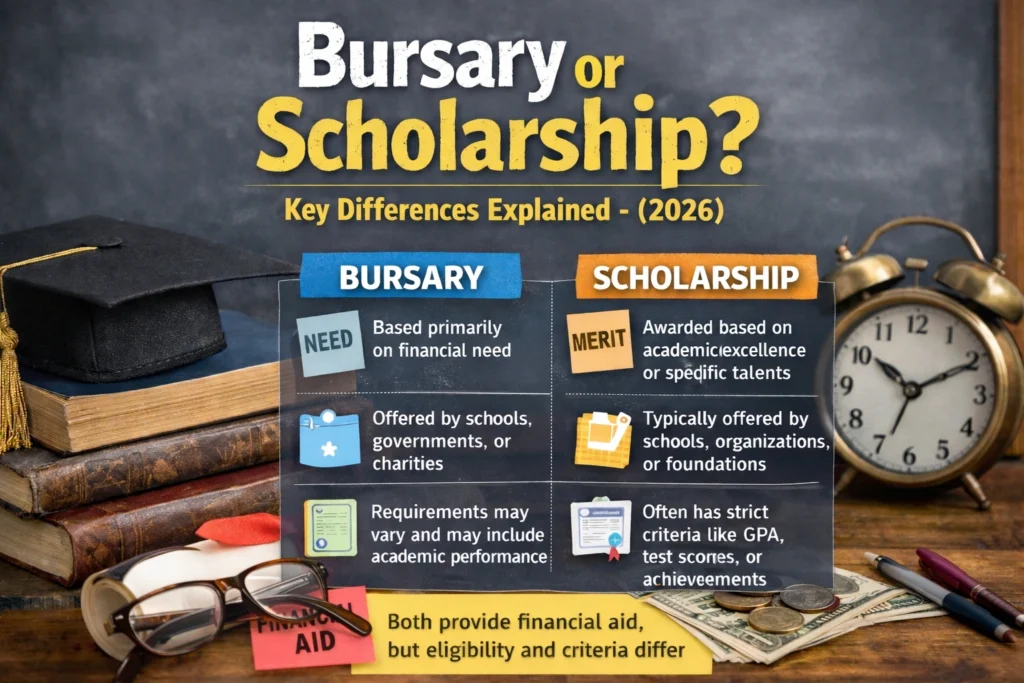
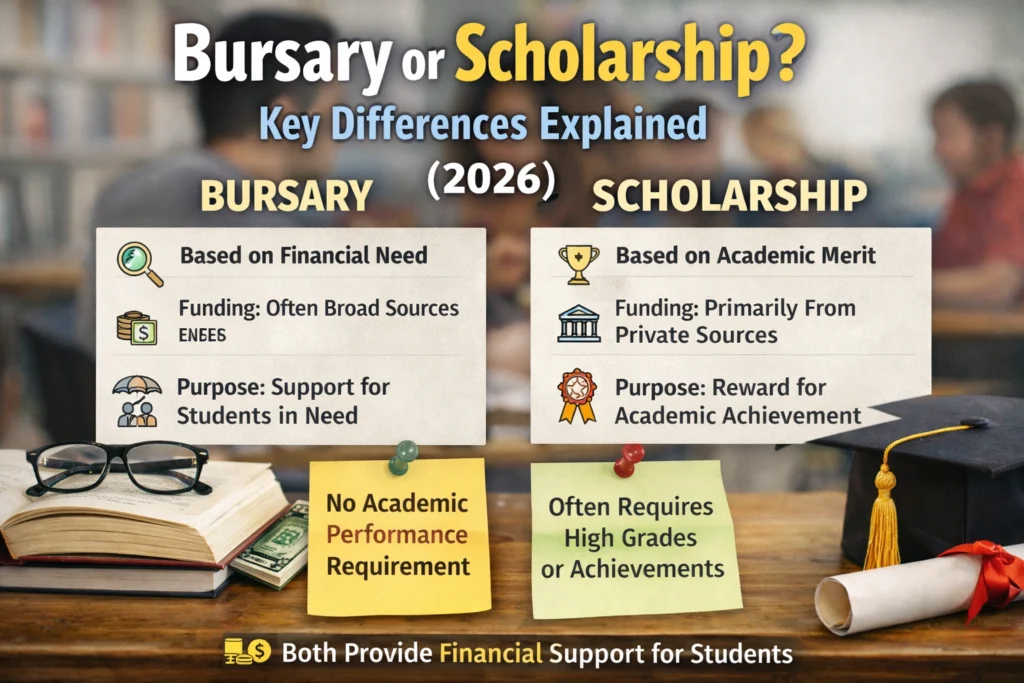
- A bursary is usually awarded based on financial need.
- A scholarship is typically awarded based on merit (like academic performance, sports, or talent).
However, the reality is a bit more nuanced. Some bursaries consider performance, and some scholarships consider financial need. The key difference lies in their primary purpose.
Think of it this way:
- Bursaries help students who cannot afford education
- Scholarships reward students who have demonstrated excellence
ALSO APPLY FOR: Boikanyo Solar Bursary 2026
ALSO APPLY FOR: Masakh’iSizwe Bursary 2027
Understanding Bursaries: Financial Support That Opens Doors
A bursary is a form of financial aid given to students who may not have the financial means to pay for their education.
How Bursaries Work
Bursaries are usually offered by:
- Government departments
- Private companies
- NGOs and foundations
They are designed to ensure that financial hardship doesn’t prevent capable students from studying.
Key Features of Bursaries
- Means-tested: You often need to show proof of household income.
- Targeted fields: Many bursaries are linked to specific industries (e.g., engineering, teaching, healthcare).
- Service obligations: Some bursaries require you to work for the sponsor after graduating.
- Covers more than tuition: May include accommodation, books, meals, and even a stipend.
Example
Imagine a student from a low-income household who wants to study civil engineering but cannot afford university fees. A construction company might offer a bursary that covers all costs in exchange for the student working for them after graduation.
Understanding Scholarships: Rewarding Excellence
Scholarships are awarded to students based on achievement rather than financial need.
How Scholarships Work
Scholarships are typically awarded for:
- Academic excellence
- Sporting achievements
- Artistic talent
- Leadership skills
They can come from:
- Universities
- Private organizations
- International programs
Key Features of Scholarships
- Merit-based: Your performance is the main factor.
- Highly competitive: Top marks or achievements are often required.
- Flexible use: Some scholarships allow you to choose your field of study.
- No repayment: Usually no obligation to work for the sponsor.
Example
A student who consistently achieves top grades and excels in mathematics might receive a scholarship from a university that covers tuition fees as a reward for their academic excellence.
Bursary vs Scholarship: A Clear Comparison
Here’s a simple way to compare the two:
| Feature | Bursary | Scholarship |
|---|---|---|
| Main Criteria | Financial need | Merit (academic, talent, sport) |
| Proof Required | Income documents | Certificates, results, achievements |
| Obligation | Often requires work-back | Usually none |
| Competition | Moderate | Very high |
| Coverage | Often comprehensive | May be partial or full |
Bursary or Scholarship? Key Differences Explained in Real Life
Let’s break it down with a practical scenario.
Scenario 1: Financial Need Comes First
Thabo is a strong student but comes from a household with very limited income. Even though his marks are good, his biggest challenge is affordability.
Best option: Bursary
Because bursaries are designed to support students like him.
Scenario 2: Top Academic Performer
Aisha consistently ranks at the top of her class and has won multiple academic awards. Her family can afford university, but she wants recognition and financial support.
Best option: Scholarship
Because scholarships reward high achievement.
Scenario 3: A Bit of Both
Lerato has excellent grades but also comes from a low-income household.
Best option: Apply for both
Many students qualify for both bursaries and scholarships—and can even combine them in some cases.
Step-by-Step: How to Decide Which One to Apply For
Choosing between a bursary and a scholarship doesn’t have to be complicated. Follow this simple process:
Step 1: Assess Your Financial Situation
Ask yourself:
- Can your family afford tuition and living expenses?
- Will you need full financial support?
If yes → focus on bursaries
If no → scholarships may be enough
Step 2: Evaluate Your Strengths
Consider:
- Academic performance
- Sports achievements
- Leadership roles
- Special talents
Strong performance → scholarships
Moderate performance + financial need → bursaries
Step 3: Check Requirements Carefully
Each opportunity is different. Look at:
- Eligibility criteria
- Required documents
- Deadlines
Never assume all bursaries or scholarships are the same.
Step 4: Apply Broadly
Don’t limit yourself. Apply for:
- Government bursaries
- Private company bursaries
- University scholarships
- External scholarships
More applications = higher chances of success.
ALSO READ ABOUT: What Is an Artisan Qualification and How Long It Take: (2026)
Common Misunderstandings About Bursary or Scholarship? Key Differences Explained
Even though the concepts seem simple, many students get them wrong. Let’s clear up some common myths.
“Bursaries and scholarships are the same”
Not true. While both provide funding, they serve different purposes and have different criteria.
“You must be poor to get any funding”
Not always. Scholarships are often awarded regardless of financial status.
“Only top students get scholarships”
While high performance helps, some scholarships also reward leadership, creativity, or community involvement.
“Bursaries are easier to get”
Not necessarily. Some bursaries are highly competitive, especially those offering full funding.
“You can only have one”
In some cases, you can combine funding sources—as long as the terms allow it.
Why This Difference Matters More Than You Think
Understanding the difference between a bursary and a scholarship isn’t just academic—it can directly affect your future.
If you apply for the wrong type of funding:
- You might waste time on applications you don’t qualify for
- You could miss out on opportunities better suited to your situation
- You may reduce your chances of getting funding
On the other hand, applying strategically:
- Increases your chances of success
- Helps you secure full or partial funding
- Reduces financial stress during your studies
Practical Tips to Improve Your Chances
No matter which option you choose, these tips can make a big difference:
1. Start Early
Many applications close months before the academic year begins.
2. Prepare Documents in Advance
Common requirements include:
- ID documents
- Academic transcripts
- Proof of income
- Motivation letters
3. Write a Strong Motivation Letter
Explain:
- Your goals
- Why you deserve funding
- How the opportunity will impact your future
4. Keep Improving Your Profile
Even small improvements help:
- Better grades
- Volunteering
- Leadership roles
Key Takeaways
- Bursaries focus on financial need, while scholarships focus on merit.
- Bursaries often come with conditions, such as working for the sponsor.
- Scholarships are usually reward-based and flexible.
- You can apply for both at the same time.
- Choosing the right option depends on your financial situation and achievements.
Frequently Asked Questions (FAQs)
1. Can I apply for both a bursary and a scholarship at the same time?
Yes, and you should. Applying for both increases your chances of securing funding.
2. Do I have to pay back a bursary?
Usually not, but some bursaries require you to work for the sponsor after graduating.
3. Are scholarships only for top students?
Mostly, but not always. Some also consider leadership, talent, or community involvement.
4. Which is better: a bursary or a scholarship?
Neither is “better”—it depends on your situation. If you need financial support, a bursary is ideal. If you excel academically or in other areas, a scholarship is a great option.
Final Thoughts
Understanding Bursary or Scholarship? Key Differences Explained can make a real difference in your education journey. These funding opportunities are not just about money—they’re about access, opportunity, and future success.
If you take the time to understand how each works and apply strategically, you put yourself in a much stronger position to achieve your academic goals—without being held back by financial barriers.
ALSO APPLY FOR: Boikanyo Solar Bursary 2026
ALSO APPLY FOR: Masakh’iSizwe Bursary 2027
ALSO READ ABOUT: What Is an Artisan Qualification and How Long It Take: (2026)