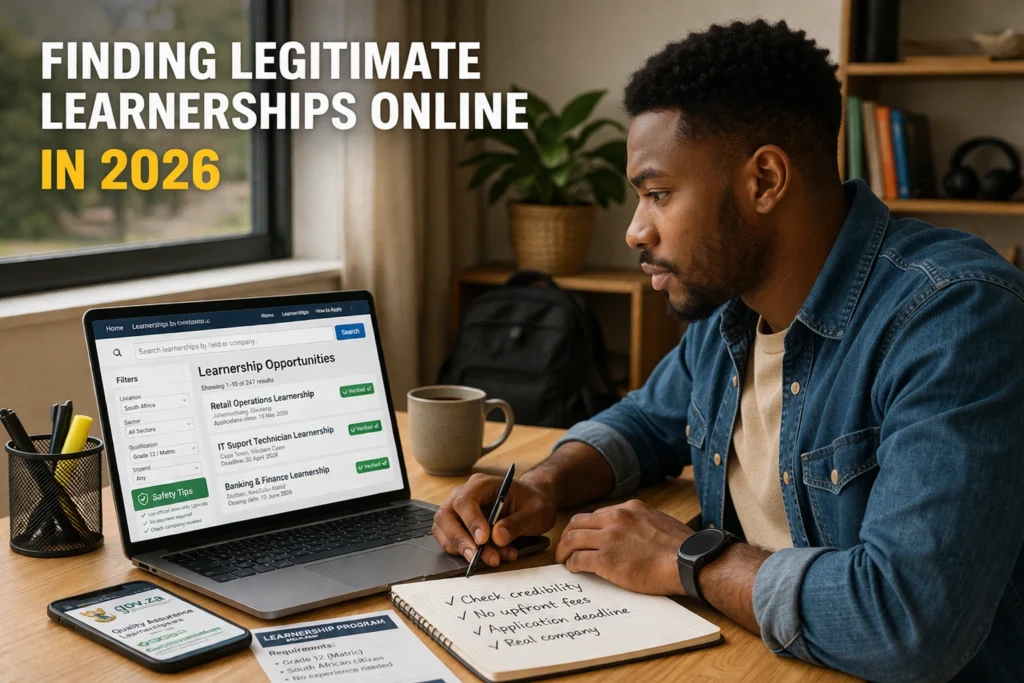

Finding Legitimate Learnerships Online: On a Tuesday morning in Johannesburg, 23-year-old Thabo sat in front of his laptop, scrolling through yet another job listing that promised “guaranteed placement” after a learnership—for a small upfront fee. He hesitated. The offer looked polished, the website professional. But something felt off.
A week earlier, his friend had paid for a similar “opportunity” and never heard back.
Thabo’s experience is far from unique. Across South Africa, thousands of young people are searching for ways to enter the workforce through learnerships—structured programmes that combine training with real work experience. But as demand grows, so does the number of scams and misleading listings.
Understanding How to Find Legitimate Learnerships Online has become less of a simple job-hunting skill and more of a necessary survival strategy in today’s digital economy.
The Digital Gold Rush for Learnerships
Learnerships have long been one of South Africa’s most important pathways into employment. Backed by Sector Education and Training Authorities (SETAs), they offer both accredited training and practical experience—something many graduates and school leavers desperately need.
But in 2026, the landscape has shifted.
The rise of online job platforms, social media recruitment, and WhatsApp-based applications has made access easier—but also riskier. Anyone can create a convincing advert. Anyone can claim affiliation with a major company.
And that’s where the confusion begins.
Many applicants assume that if something appears online, it must be legitimate. Unfortunately, that assumption often leads to disappointment—or worse, financial loss.
How to Find Legitimate Learnerships Online Without Getting Scammed
The truth is, legitimate learnerships do exist online—you just need to know where and how to look.
Start by focusing on verified sources. Government-linked platforms, official company career pages, and recognized job portals remain the safest entry points. Learnerships funded through SETAs are usually advertised through official channels, not random social media pages.
One of the most reliable signs of legitimacy is transparency. Real learnerships clearly outline:
- The qualification you will receive
- The duration of the programme
- The training provider or institution
- Whether there is a stipend (and how much)
- Application requirements and deadlines
If any of this information is vague or missing, treat it as a red flag.
Another key indicator is cost—or the lack of it. Legitimate learnerships do not require upfront payment. At most, you might pay for your own transport or documents, but never for “placement” or “processing.”
Thabo learned this the hard way. After weeks of trial and error, he began to notice patterns—real opportunities never asked for money, and they always linked back to official company websites.
Click here to apply for NECSA Generic Management Learnerships 2026
Click here to apply for NECSA Generic Management Learnerships 2026
Click here to apply for Ampath Phlebotomy Technician Learnership 2027
Finding Legitimate Learnerships Online: Why So Many Fake Learnerships Exist Today
It’s tempting to blame job seekers for falling for scams, but the reality is more complex.
South Africa’s youth unemployment rate remains one of the highest globally. For many, learnerships are not just opportunities—they are lifelines. This urgency creates a perfect environment for exploitation.
Scammers understand this. They mimic real companies, copy logos, and even fabricate testimonials. Some go as far as conducting fake interviews.
The shift to digital platforms has made this easier than ever. A single WhatsApp broadcast or Facebook post can reach thousands within minutes.
What’s changed recently is the level of sophistication. Fake listings now look nearly identical to legitimate ones, making it harder to distinguish between the two.
A Closer Look: Verifying Opportunities Before You Apply
Finding a learnership is no longer just about searching—it’s about verifying.
When you come across an opportunity, pause before applying. Ask yourself:
- Does the company have an official website?
- Is the listing also published there?
- Are contact details consistent and professional?
- Can you trace the training provider or SETA involved?
Cross-checking takes a few extra minutes but can save weeks—or months—of frustration.
It’s also worth paying attention to email addresses. Legitimate organizations use domain-based emails (e.g., @companyname.co.za), not free services like Gmail or Yahoo for official recruitment.
Another overlooked step is researching past programmes. Established companies often run learnerships annually. If you can’t find any history of previous intakes, proceed with caution.
The Role of Social Media: Opportunity and Risk
Social media has become one of the biggest gateways to learnership information. Many companies now announce programmes on platforms like LinkedIn, Facebook, and even TikTok.
But this convenience comes with risks.
A post shared thousands of times doesn’t guarantee authenticity. In fact, viral posts are often the ones scammers exploit the most.
That doesn’t mean you should avoid social media altogether. Instead, use it as a starting point, not the final source. If you see an opportunity, trace it back to its origin. Find the official page. Confirm the details.
Think of social media as a tip-off—not proof.
Expert Insight: Why Verification Skills Matter More Than Ever
In today’s job market, digital literacy is no longer optional—it’s essential.
Recruitment processes are increasingly moving online, and with that shift comes a new responsibility for job seekers: the ability to evaluate information critically.
Knowing How to Find Legitimate Learnerships Online is not just about avoiding scams. It’s about building a mindset of careful decision-making.
Those who take the time to verify opportunities often develop stronger application habits. They apply to better programmes, avoid wasted effort, and ultimately improve their chances of success.
In a competitive environment, that edge matters.
Practical Signs That a Learnership Is Legitimate
While every opportunity is different, there are consistent markers you can rely on:
- It is linked to a recognized company or institution
- It does not require upfront payment
- It provides clear programme details
- It uses professional communication channels
- It can be verified through multiple sources
These indicators won’t guarantee legitimacy on their own, but together they create a strong foundation for trust.
Click here to apply for NECSA Generic Management Learnerships 2026
Click here to apply for NECSA Generic Management Learnerships 2026
Click here to apply for Ampath Phlebotomy Technician Learnership 2027
Why This Topic Matters Right Now
The conversation around employment in South Africa is evolving. Traditional job paths are becoming less predictable, and alternative routes like learnerships are gaining importance.
At the same time, digital access has expanded rapidly. More people are searching for opportunities online than ever before.
This combination—high demand and easy access—has created both opportunity and vulnerability.
Understanding how to navigate this space safely is no longer a niche skill. It’s a critical part of participating in the modern workforce.
For many young people, the difference between a legitimate learnership and a scam can shape their entire career trajectory.
FAQ
1. Do legitimate learnerships ever ask for payment?
No. Genuine learnerships are funded by companies or SETAs. Any request for upfront payment should be treated as a warning sign
2. Can I trust learnerships advertised on social media?
Only after verification. Always confirm the opportunity through official company websites or trusted platforms.
3. What should I do if I suspect a scam?
Avoid engaging further, do not send money or personal documents, and report the listing if possible. Sharing awareness can help protect others.
The Bigger Picture: Building Smarter Job Search Habits
Thabo eventually found a legitimate learnership—one that didn’t promise instant success, but offered real training and a modest stipend. It wasn’t flashy, and it didn’t go viral online. But it was real.
His journey highlights something many job seekers overlook: success in today’s job market isn’t just about finding opportunities—it’s about recognizing the right ones.
Learning How to Find Legitimate Learnerships Online is part of a broader shift toward smarter, more intentional job searching. It requires patience, attention to detail, and a willingness to question what you see.
In a digital world full of noise, those who learn to filter signal from distraction will always have an advantage.
And sometimes, that advantage is the difference between starting a career—and starting over.
Click here to apply for NECSA Generic Management Learnerships 2026
Click here to apply for NECSA Generic Management Learnerships 2026
Click here to apply for Ampath Phlebotomy Technician Learnership 2027