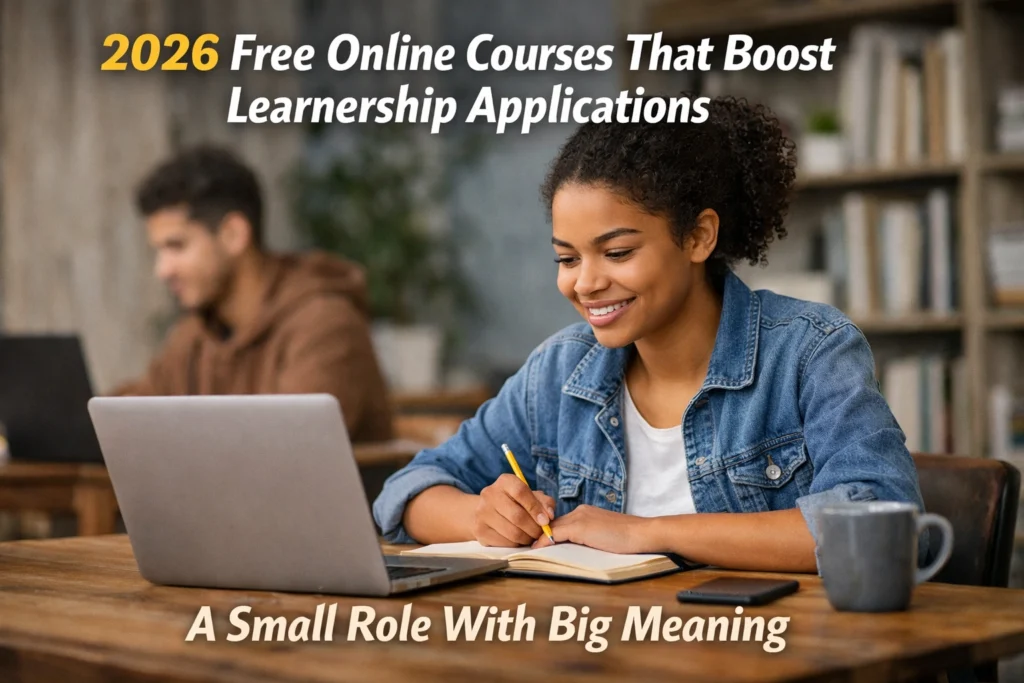

2026 Free Online Courses That Boost Learnership Applications: Like many young South Africans, Lerato has done what she was told would be enough. She finished matric. She applied to learnerships. She followed the instructions carefully. But something isn’t working—and she knows it.
Then, almost by accident, she taps on a free online course link shared in a WhatsApp group. It’s short. Practical. And within a few weeks, it changes how she applies, what she includes in her CV, and—eventually—her results.
Her story is becoming increasingly common in 2026.
Because right now, 2026 Online Courses For Free -That Improve Learnership Applications are quietly reshaping how young people compete for limited opportunities.
Why Learnership Applications Are Getting More Competitive
Across South Africa, learnerships remain one of the most accessible pathways into the workforce. They offer something many young people desperately need: paid experience plus a qualification.
But here’s the reality in 2026:
There are far more applicants than available positions.
Employers are no longer just looking for basic eligibility. They’re looking for signals—small indicators that show initiative, readiness, and adaptability.
A matric certificate alone doesn’t stand out anymore.
This shift has created a subtle but important divide:
- Applicants who submit standard CVs
- Applicants who show extra effort through self-learning
That second group is growing fast—and free online courses are the reason why.
ALSO APPLY FOR: Unilever Automated Packaging Learnerships 2026
ALSO APPLY FOR: Pepkor Learnership 2026 Apply Now
The Rise of 2026 Online Courses For Free -That Improve Learnership Applications
Not long ago, online learning felt distant or expensive. Today, it’s accessible from almost any smartphone with data—even more so with zero-rated platforms and public Wi-Fi expansion across cities and townships.
What’s changed in 2026 is not just access—but purpose.
Young applicants are no longer taking random courses. They are choosing short, targeted programs that directly improve their employability.
Courses in areas like:
- Customer service basics
- Workplace communication
- Microsoft Office fundamentals
- Health and safety awareness
- Retail operations
These aren’t advanced degrees. They’re practical skill boosters—and they matter.
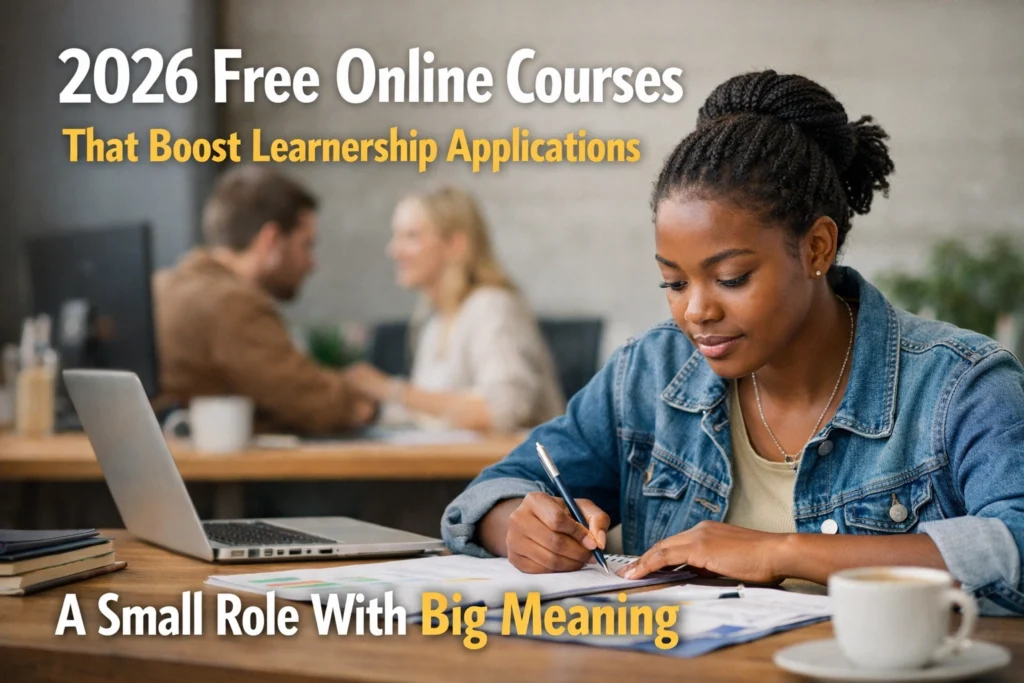
When Lerato reapplied for a retail learnership, she added just two short certifications to her CV. During the interview, the recruiter spent more time asking about those courses than her school marks.
That moment told her everything.
Small Skills, Big Signals: What Employers Actually Notice
One hiring manager at a Gauteng-based retail company recently shared a simple observation:
“Most applicants look the same on paper. What stands out is effort.”
Free online courses send a signal that goes beyond qualifications. They show:
- Initiative – You didn’t wait for an opportunity; you prepared for it
- Digital literacy – You can navigate online systems and learning platforms
- Commitment – You finished something voluntarily
In a country where youth unemployment remains high, these signals carry weight.
And importantly, they level the playing field.
Not everyone can afford college or private training. But many can complete a free online course in a few hours or days.
A Shift Happening in Townships and Rural Areas
In places like Limpopo, Eastern Cape, and parts of North West, community libraries and youth centers are becoming informal learning hubs.
Groups of young people gather not just to apply for jobs—but to prepare differently.
Some share downloaded course materials. Others help each other understand lessons. There’s even a growing trend of peer accountability—friends checking whether each other has completed a module.
This isn’t formal education.
But it’s powerful.
Because it reflects something deeper: a mindset shift from waiting to actively building employability.
What Types of Free Courses Actually Help?
Not all courses carry equal weight. The most effective ones are those aligned with real workplace expectations.
Here’s a practical breakdown:
Courses that improve learnership applications most effectively:
- Basic computer skills (Word, Excel, email usage)
- Customer service and communication
- Time management and workplace readiness
- Industry-specific introductions (retail, logistics, hospitality)
- Health, safety, and compliance basics
Short, focused courses often work better than long ones. Employers are not necessarily looking for depth—they’re looking for relevance.
Completing three short courses that connect directly to the learnership is often more impactful than one unrelated certificate.
Expert Insight: Why This Trend Matters Beyond Applications
There’s a deeper implication behind the rise of 2026 Online Courses For Free -That Improve Learnership Applications.
It’s not just about getting selected—it’s about changing the entry-level workforce itself.
When thousands of applicants begin arriving with basic digital skills, communication training, and workplace awareness, employers start adjusting expectations.
Over time, this can:
- Raise the baseline skill level of entry-level workers
- Reduce onboarding and training costs for companies
- Increase productivity early in employment
- Improve long-term career mobility for young workers
In simple terms, free courses don’t just help individuals—they gradually reshape the job market.
ALSO READ ABOUT: How to Write a Motivational Letter for Learnerships
ALSO APPLY FOR: Pepkor Learnership 2026 Apply Now
ALSO APPLY FOR: Unilever Automated Packaging Learnerships 2026
The Psychological Impact: Confidence You Can’t Fake
One of the least discussed benefits of free online learning is confidence.
Applicants who complete courses tend to:
- Speak more clearly in interviews
- Understand workplace language
- Ask better questions
- Present themselves with more certainty
This matters.
Because many learnership interviews are not just about knowledge—they’re about presence.
Lerato noticed this herself. The second time she sat in an interview room, she didn’t feel like she was hoping for a chance. She felt like she had something to offer.
That shift is subtle—but powerful.
Common Mistakes Applicants Still Make
Even with access to free learning, some applicants don’t see results. Often, the issue isn’t effort—it’s direction.
Here are a few common missteps:
- Taking unrelated courses just to collect certificates
- Not adding completed courses to a CV properly
- Failing to explain what they learned during interviews
- Starting courses but not finishing them
The value of a course isn’t just in completing it—it’s in how you use it.
FAQ
1. Do free online courses really make a difference in learnership applications?
Yes, especially when they are relevant. They help you stand out and show initiative, which many employers value as much as formal qualifications.
2. How many courses should I complete before applying?
There’s no fixed number, but 2–4 relevant courses are usually enough to strengthen an application without overwhelming your CV
3. Can I include incomplete courses on my CV?
It’s better to include only completed courses. However, you can mention ongoing learning during interviews if it’s relevant.
The Bigger Picture: A New Way Into Opportunity
South Africa’s employment landscape isn’t changing overnight. Learnerships are still limited. Competition is still intense. And many young people still face real structural barriers.
But something important is shifting beneath the surface.
Access to knowledge—once limited by cost and location—is becoming more open. And with it, a new kind of candidate is emerging.
Not necessarily more qualified on paper.
But more prepared. More aware. More proactive.
The rise of 2026 Online Courses For Free -That Improve Learnership Applications is not a magic solution. It won’t guarantee success.
But it changes the odds.
For Lerato, it meant turning repeated rejection into a single opportunity—and that opportunity into a starting point.
For thousands of others, it may do the same.
And in a country where one opportunity can change everything, that shift matters more than it might seem.
ALSO APPLY FOR: Pepkor Learnership 2026 Apply Now
ALSO APPLY FOR: Unilever Automated Packaging Learnerships 2026